
How Many People Own Bitcoin? The Blockchain Counts Addresses, Not Owners
No one can count bitcoin owners directly, but published estimates give a range. River, a Bitcoin financial services company, estimates that about 825,000 people own at least one whole bitcoin, within a range of 600,000 to 1 million. Surveys of any-amount ownership run much higher. In 2025, Gallup found that 14 percent of U.S. adults own bitcoin or another cryptocurrency.
Does one bitcoin address equal one owner?
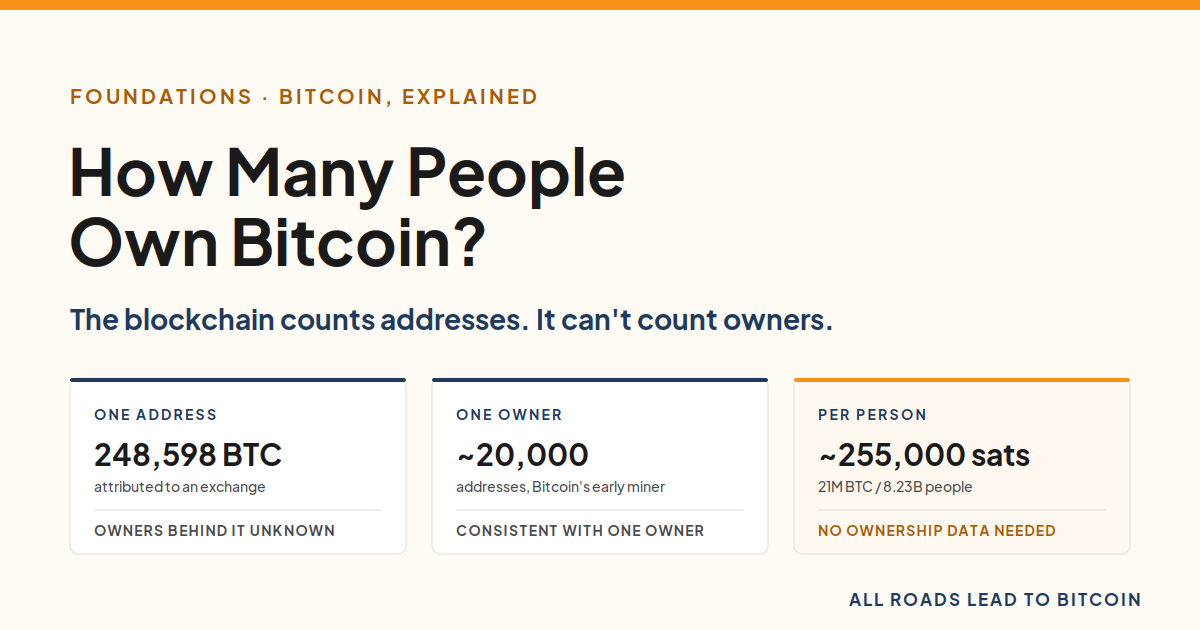
The largest address on the Bitcoin blockchain holds about 248,600 BTC. An address is a destination for coins, something like an account number with no name attached. BitInfoCharts, which tracks the chain, attributes this one to Binance as a cold wallet, meaning offline storage the exchange controls on behalf of its customers. How many customers? The chain can’t say, because all it sees is one address.
In 2009, the person or group who mined much of Bitcoin’s first two years sent each block reward to a fresh address. Sergio Lerner, the researcher who identified that mining pattern in 2013, wrote that “each block was mined to a different randomly generated address.” River puts those coins at about 968,000, which at 50 BTC per block works out to roughly 20,000 addresses. Lerner’s later count is closer to 22,000 blocks. Either way, the pattern is consistent with a single owner.
Any headcount built straight from address data assumes neither of those things happens.
How many bitcoin addresses hold 0.01 BTC or 1 BTC?
As of October 18, 2026, BitInfoCharts reports about 59.8 million addresses with a balance above zero. About 12.7 million of them hold at least 0.01 BTC, which is one million satoshis. A satoshi is the smallest unit of bitcoin, one hundred-millionth of a coin, which is why you don’t have to buy a whole bitcoin to own some. About 970,550 addresses hold at least one whole bitcoin.
Small addresses dominate the count and barely register in the supply. Addresses under 0.01 BTC make up nearly 79 percent of all funded addresses, yet together they hold about a quarter of one percent of the coins. The 12.7 million addresses at or above that line hold the other 99.75 percent.
| Address balance | Addresses | Share of addresses | BTC held | Share of BTC |
|---|---|---|---|---|
| Under 0.01 BTC | 47,029,062 | 78.7% | 50,898 | 0.25% |
| 0.01 to 0.1 BTC | 8,269,907 | 13.8% | 278,070 | 1.38% |
| 0.1 to 1 BTC | 3,494,161 | 5.8% | 1,065,467 | 5.30% |
| 1 to 100 BTC | 950,144 | 1.6% | 6,260,616 | 31.15% |
| 100 BTC and up | 20,406 | 0.0% | 12,442,059 | 61.91% |
Funded addresses grouped by balance, as of October 18, 2026. Source: BitInfoCharts, rolled up from its distribution table.
None of those balances depend on trusting BitInfoCharts. Anyone running a full node, which is a computer keeping its own copy of Bitcoin’s software and ledger, can rebuild the same table, the same way you can verify Bitcoin supply yourself. The company names attached to the biggest addresses are a different matter. Those come from outside research, not from the chain.
Divide 12.7 million addresses by 8.2 billion people and you get about 0.15 percent. That division treats every address as a person.
Why the blockchain can’t show how many people own bitcoin
Four things break the link between addresses and owners, and they push the count in different directions.
One person often has many addresses, which inflates the count. Most modern wallets offer a fresh address each time you ask to receive, and they send the change from every spend to another new address. Someone who has bought bitcoin a dozen times may hold it across a dozen addresses or more. The early miner’s 20,000 addresses are the extreme case.
One address can hold coins for many people, which deflates the count. Exchanges concentrate much of their customers’ bitcoin in a few very large wallets, like the Binance address above. Four of the five largest addresses on the chain are attributed to exchange or brokerage cold wallets (two for Binance, one for Robinhood, and one for Bitfinex), and the fifth is attributed to Tether. Every customer behind those wallets is invisible to an address count.
Some people have exposure to bitcoin without holding any coins of their own. A shareholder in a spot bitcoin ETF owns shares in a fund, and the fund’s custodian holds the coins in addresses it controls. River estimated that funds and ETFs together held about 1.63 million BTC as of August 2025. Owning bitcoin adjacent securities isn’t the same as holding the coins yourself, and those shareholders appear nowhere on the chain.
And some addresses may no longer be spendable by anyone, because no one has the keys anymore. Coins whose keys are lost still show a balance forever, which inflates the count of people who actually hold bitcoin.
Bitcoin’s earliest miner sent each block reward to a different, randomly generated address. Roughly a million coins sit spread across about 20,000 to 22,000 of them, almost entirely untouched since 2009 and 2010. To an address count, that one owner looks like 20,000 separate holders.
How many people own one whole bitcoin?
River published an estimate in August 2026. It put the number of individuals who own at least one whole bitcoin at about 825,000 worldwide, within a plausible range of 600,000 to 1 million. That works out to roughly one in ten thousand people worldwide. River sells bitcoin, so it has a stake in the subject, and it also published how it got there.
It started from the roughly 972,000 addresses that held one or more bitcoin in August. It removed the addresses it could tie to companies, governments, ETFs, and exchanges. Because exchange balances hide their individual owners, it then assumed exchange customers own bitcoin in roughly the same pattern seen on the public chain, and modeled them that way. River’s post names the limit. Because the blockchain records addresses rather than people, owners can’t be counted directly.
Notice which way River’s number moved. It landed below the address count, so at the one-bitcoin line its model finds more addresses per person than people per address.
Lost-coin estimates show how much depends on what goes into the count. In 2017, Chainalysis estimated that about 2.77 million to 3.79 million bitcoin were lost, roughly 17 to 23 percent of the supply at the time. In 2025, River put lost coins at about 1.58 million. The difference shrinks once you check the buckets. Chainalysis counted the early miner’s roughly one million coins as lost, while River listed them separately, at about 968,000. Combined, River’s two figures come to about 2.55 million, a little below the bottom of Chainalysis’s range, from estimates made eight years apart.
How many people own any bitcoin?
Surveys approach the question differently. They ask people directly, so they count humans instead of addresses, but they can’t see a single coin.
In a June 2025 Gallup survey of 2,017 U.S. adults, 14 percent said they own bitcoin or another cryptocurrency. That figure covers only the United States, relies on what people report about themselves, and folds bitcoin together with every other cryptocurrency. It also says nothing about how much anyone holds, which is the part the chain measures well.
How much bitcoin is there per person?
One calculation needs no ownership data at all. Bitcoin’s supply is capped at slightly under 21 million bitcoin, a limit checked by every node on the network. The UN’s World Population Prospects puts the world at about 8.23 billion people in 2025. That population figure is a modeled estimate with a published method rather than a headcount, and it’s stable enough for this arithmetic.
Divide one by the other and each person’s equal share comes to about 0.00255 BTC, or about 255,000 satoshis. Against the roughly 20.1 million coins mined so far, the share drops to about 244,000 sats. Lost coins shrink the usable pool further, by an amount every lost-coin estimate cited here puts in the millions.
How much is 0.01 BTC, or a million sats?
A million satoshis is 0.01 BTC. Measured against the equal share, it’s a little under four people’s worth of bitcoin at the full 21 million, and a bit over four against the coins mined so far.
That tells us something about the supply. It says nothing about where anyone ranks among bitcoin owners. It also counts all 8.2 billion people, including infants and people who will never hold bitcoin. It’s simply a way to compare a holding with a supply divided evenly.
The blockchain shows, to the satoshi, how bitcoin is spread across addresses. It can’t tell us how many people are behind those addresses. For that, we’re left with estimates, surveys, and some arithmetic about the supply.
Keep going
The same public ledger that can’t count owners can count every coin. Checking that number yourself takes a full node and some patience.
How to verify Bitcoin’s supplyCommon questions
How many people own bitcoin?
No one can count them directly, because the blockchain records balances by address and holds no names. River estimates that about 825,000 individuals own at least one whole bitcoin, with a range of 600,000 to 1 million. Survey figures for owners of any amount run much higher. In 2025, Gallup found that 14 percent of U.S. adults own bitcoin or another cryptocurrency.
Is owning 1 bitcoin rare?
River estimates that between 600,000 and 1 million people own at least one whole bitcoin. Its central figure of about 825,000 works out to roughly one in ten thousand people worldwide. About 970,000 addresses hold one or more bitcoin, but some belong to exchanges and companies, and some individuals spread their coins across several addresses.
How many people own 0.01 bitcoin?
No one knows the number of people. About 12.7 million addresses hold at least 0.01 BTC as of October 2026, according to BitInfoCharts. That figure counts addresses, and one person can hold many while one exchange address can hold coins for many customers.
How much bitcoin is lost?
Estimates vary with method. River put lost coins at about 1.58 million in 2025 and counted the early miner’s roughly 968,000 coins separately. Chainalysis estimated about 2.77 million to 3.79 million in 2017, a range that treated the early miner’s coins as lost.
Does owning a bitcoin ETF count as owning bitcoin?
Not on the blockchain. An ETF shareholder owns shares in a fund, and the fund’s custodian holds the coins in its own addresses. The shareholder has exposure to bitcoin through the fund but holds no keys and appears nowhere on the chain.
Can I check the bitcoin address distribution myself?
Yes. The balances come straight from the public blockchain. Sites such as BitInfoCharts publish them, and anyone running a full node can reproduce them independently. The company names attached to large addresses come from outside research rather than from the chain itself.
Go deeper
- Three questions to ask about any money. Why Bitcoin’s supply is something you can count yourself, and what checking it costs.
- Bitcoin’s real supply cap. What “21 million” rounds away, including coins destroyed and never claimed.
- You don’t need to buy a whole bitcoin. Satoshis, and why fractions are the normal way to hold it.
- The Bitcoin myths, explained. The full series this explainer sits alongside.
Sources
- BitInfoCharts, Bitcoin distribution and richest addresses. Address counts, balances, and wallet attributions, snapshot October 18, 2026.
- River, estimate of individuals holding one or more bitcoin (August 2026), and River, bitcoin ownership distribution (August 2025).
- Gallup, Cryptocurrency Still Has Limited Main Street Appeal (2025).
- Fortune, on Chainalysis’s estimate of lost bitcoin (2017).
- Sergio Demian Lerner, The Well Deserved Fortune of Satoshi Nakamoto (2013).
- UNFPA World Population Dashboard, using UN World Population Prospects 2024.
Everything on this site is for educational purposes only. It is not financial, investment, tax, or legal advice. Bitcoin carries real risk. Prices move, sometimes sharply. Do your own research, think for yourself, and speak with a qualified professional before acting on anything you read here.