
Bitcoin Myths · The Full Series
Twenty Bitcoin Myths. Here Is What the Evidence Shows.
Bitcoin is one of the most misrepresented subjects in financial media. Most criticisms recycle the same handful of claims (energy use, volatility, crime) without checking the data or comparing Bitcoin to the systems it competes with. This is the reference for all twenty.
The most common Bitcoin myths cluster around four themes: environmental impact, price instability, criminal use, and regulatory vulnerability. In each case, the data tells a different story than the headline. Bitcoin uses less energy than global banking. Its volatility has declined with every market cycle. Illicit transactions account for less than 0.2% of activity, according to Chainalysis. And no government has successfully shut down the decentralized network. Each myth in this series gets the same treatment: the claim, the evidence, and the comparison that most coverage skips.
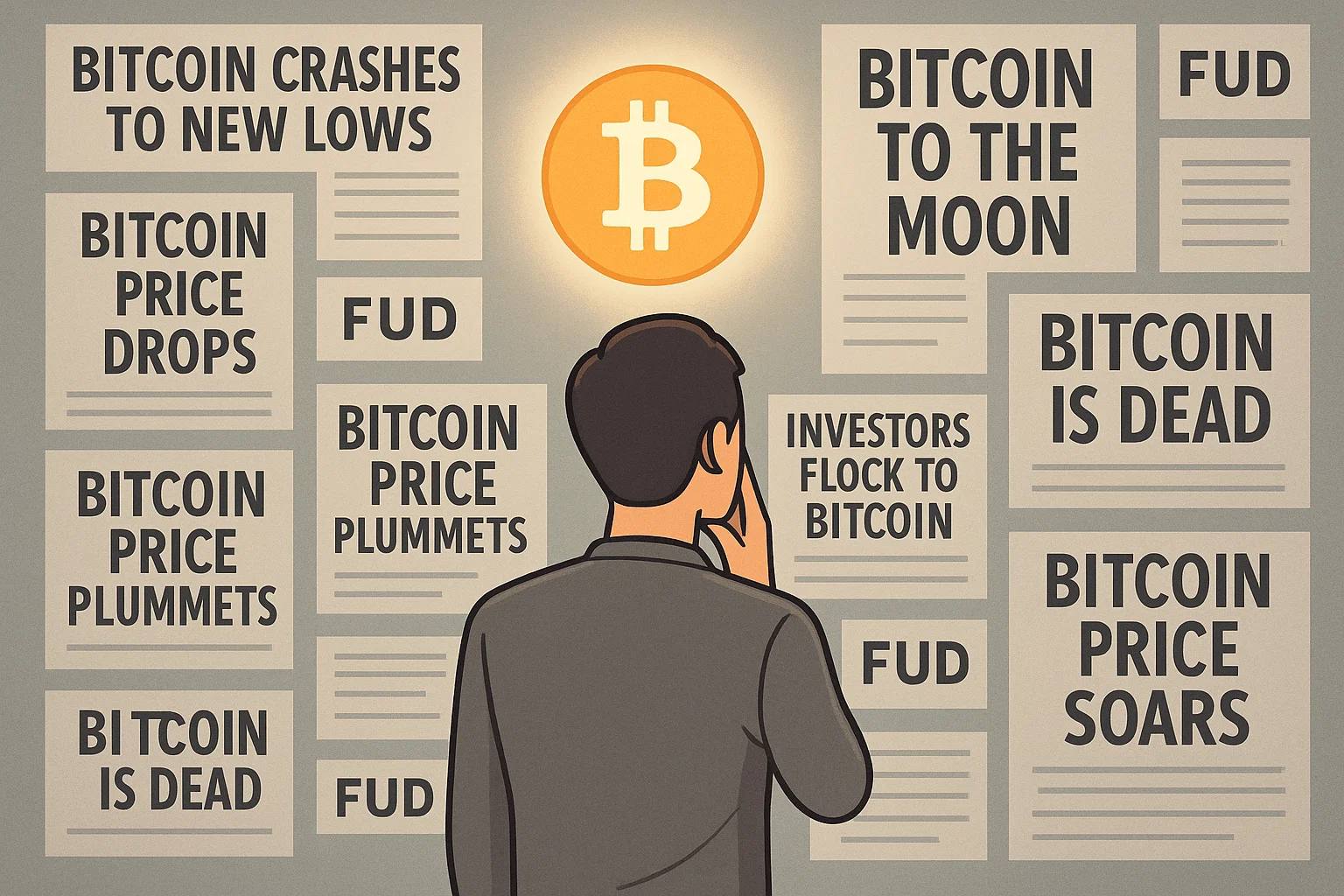
Bitcoin accumulates myths faster than most technologies. Some start from genuine confusion. Some are five years out of date. Some conflate Bitcoin with the broader crypto market. All of them are worth examining directly, with the data that most coverage does not include.
The twenty entries below cover the full spectrum of what skeptics, journalists, regulators, and newcomers most commonly get wrong. All twenty are fully researched, cited, and linked. The series is complete.
The 20 Bitcoin Myths: Full Reference Table
| # | The Myth | What the Evidence Shows |
|---|---|---|
| 1 | Bitcoin uses too much energy | Bitcoin uses roughly 138 TWh per year, well below the global banking system’s 263 TWh (Galaxy Digital, 2021). More than 52% of mining now runs on sustainable energy sources, and the share grows every year as miners follow cheap, stranded power. |
| 2 | Bitcoin is too volatile to be useful | Volatility is a feature of early monetization, not a permanent condition. It has declined with every market cycle. In economies where local currencies lose 30 to 80 percent of purchasing power annually, Bitcoin’s price swings are already the more stable option. |
| 3 | Bitcoin is only used by criminals | Illicit activity was under 1% of all crypto activity, according to Chainalysis. Bitcoin’s public blockchain makes every transaction permanently traceable, which is why cash remains the preferred instrument for serious financial crime. |
| 4 | Bitcoin is a speculative bubble | Bitcoin has recovered from every major correction in its history and reached new highs. Its fixed supply and growing institutional adoption distinguish it from assets whose price rises depend solely on sentiment rather than fundamental scarcity. |
| 5 | Governments can ban Bitcoin | Governments can restrict access, but cannot stop the protocol. China banned Bitcoin mining in 2021. The network did not skip a beat. Bitcoin runs on tens of thousands of independent nodes worldwide with no central point of control. |
| 6 | You need to buy a whole Bitcoin | Bitcoin is divisible to 100 million units called satoshis. You can buy any dollar amount. The myth confuses unit price with minimum purchase, the same error as assuming you cannot buy a fraction of a share of stock. |
| 7 | Bitcoin has no physical form or utility | Bitcoin is digital property. Its value comes from verifiable ownership and permissionless transfer, not physical delivery. The same is true of all money at scale. |
| 8 | Altcoins are better than Bitcoin | Altcoins often trade features for centralization. Bitcoin remains unmatched in decentralization, network effect, security, and credible monetary policy. These properties do not transfer. |
| 9 | Real estate is a better store of value | Real estate carries liquidity constraints, counterparty risk, and geographic limits. Bitcoin is global, portable, and operates on a fixed supply schedule no institution can alter. |
| 10 | Bitcoin physically resides in your wallet | Wallets store private keys, not coins. The bitcoin lives on the blockchain ledger. Your wallet grants control over those coins; it does not contain them. |
| 11 | Your bitcoin is yours on an exchange | When you hold bitcoin on an exchange, the exchange holds the private keys. You hold a balance in their system. Self-custody eliminates counterparty risk entirely. |
| 12 | Bitcoin should be redistributed or reset | Bitcoin has no administrator and no override mechanism. Any change to its rules requires voluntary agreement from tens of thousands of independent nodes — the same participants who would lose the most from a redistribution. |
| 13 | Gold is superior to Bitcoin | Gold has millennia of monetary history. Bitcoin has a verifiable fixed supply and a supply schedule no miner, government, or discovery can alter. The comparison depends on what you are optimizing for. |
| 14 | Bitcoin has no intrinsic value | Intrinsic value is contested in traditional economics too. Bitcoin’s value comes from cryptographic scarcity, immutability, and permissionless global transfer. Whether that qualifies depends on your definition. |
| 15 | Bitcoin is a greater fool game | Bitcoin is a neutral open protocol with a fixed supply. It does not require new buyers to pay earlier holders. Those who study its design at length frequently shift from skeptics to holders, a different dynamic from speculative bubbles built on narrative alone. |
| 16 | Bitcoin is centralized by miners | Miners produce blocks, but node operators enforce the rules. No miner or mining pool can change Bitcoin’s protocol unilaterally. Any block that violates the rules is rejected by the network. |
| 17 | Bitcoin is a Ponzi scheme | A Ponzi scheme requires a central operator promising returns and paying early investors with new money. Bitcoin has no operator, no promised returns, no central party, and no dependency on new investors. The mechanics are categorically different. |
| 18 | Bitcoin is too complicated for mass adoption | Most internet users do not understand TCP/IP. Bitcoin’s user-facing tools have improved substantially and continue to do so. Complexity at the protocol layer is not a barrier to adoption; it never has been for any widely adopted technology. |
| 19 | No one accepts Bitcoin | Tens of thousands of businesses accept Bitcoin directly. The Lightning Network makes it practical for small and frequent transactions. Acceptance is growing alongside infrastructure. |
| 20 | Bitcoin can’t be a unit of account | A unit of account is the final stage every money reaches, never the first. Bitcoin already denominates its own economy in satoshis, contracts and wages are fixed in it where official money fails, and the missing ingredient, price stability, is a function of market size that grows with every cycle. |

The three most common Bitcoin criticisms (energy use, crime, and volatility) often look different when compared directly to the systems Bitcoin competes with. Banking uses more energy. Cash is the preferred instrument for serious financial crime. And in Venezuela, Nigeria, and Argentina, Bitcoin’s volatility already looks modest against local currency depreciation.
How to Read This Series
Each article in the series follows the same structure: the myth as it is commonly stated, the data that addresses it directly, and the comparison that most coverage skips. The comparisons matter because Bitcoin is rarely evaluated against the alternatives. It gets held to a standard that cash, gold, and the banking system are never asked to meet.
The articles are written for intelligent skeptics: people who have heard the criticisms and want to know whether they hold up. They are not written to convince anyone that Bitcoin is a good investment. That is a separate question, and one that depends on individual circumstances this series does not address.
Watch: The Series on YouTube
The series is collected in a YouTube playlist, starting with the video below. Each video gets the same treatment as the written articles: the claim, the data, and the comparison that most coverage skips. New videos are added as the myths publish.
Start with the myth that brought you here, or read them in order. Each one stands on its own.
Start with Myth #1: Energy →From the book
Every myth in this series is a chapter of Reasonable Doubt.
All twenty myths from this series, revised and rechecked, in one book you can read start to finish or hand to the skeptic in your life. Same standard as the site: the strongest version of each objection, the evidence, and a verdict that goes no further than the evidence does.
Paperback · $9.99 Kindle · $4.99 or free with Kindle Unlimited Listen on Spotify
New to Bitcoin? Start with the free guide, You Just Came Into Money. Now What?