
Money Is a Competition: What Really Backs Bitcoin, Gold, and the Dollar
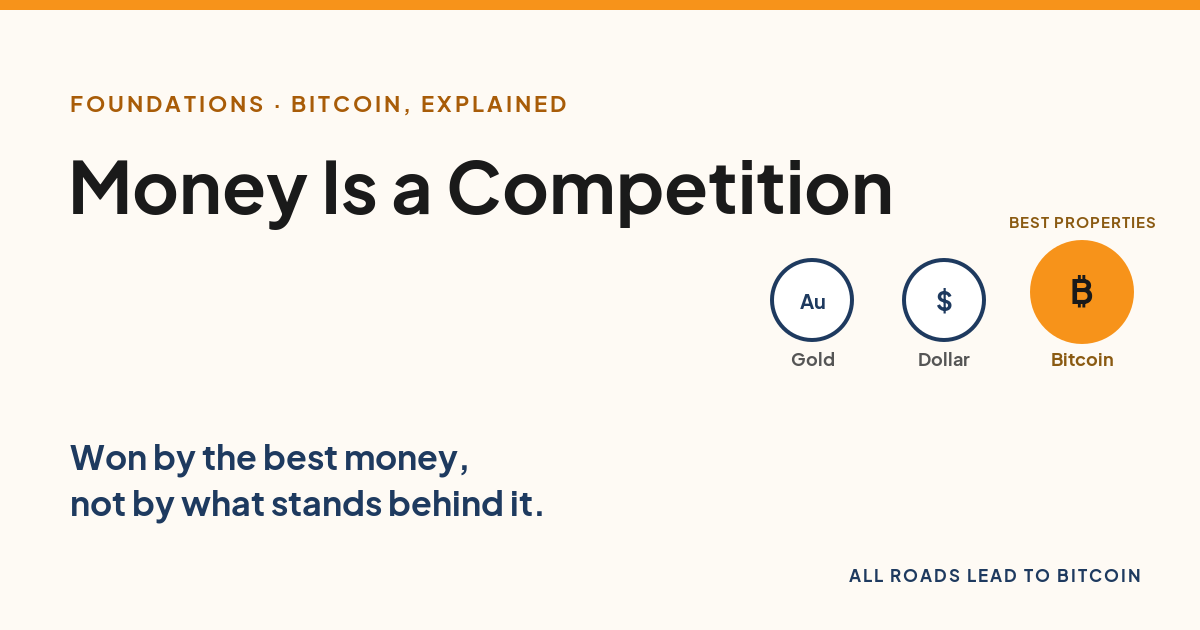
Bitcoin isn’t backed by a physical commodity or a government promise, and it doesn’t need to be. People choose money for its monetary properties: scarcity, durability, portability, divisibility, and verifiability. Gold held its place that way for thousands of years without a modern government redeeming it, and Bitcoin now competes with a different mix of qualities, some of them better suited to a digital economy.
The question hides an assumption
When someone says Bitcoin is backed by nothing, they usually have a specific picture in mind, a vault of metal behind a paper note. That picture deserves respect, because it’s how money worked within living memory. A 1928 ten-dollar gold certificate promised gold coin payable to the bearer on demand. You handed over the paper, you walked out with metal.
We don’t live in that world anymore, and neither does the dollar in your pocket. The “what is it backed by” test asks the wrong question, because the money everyone already uses doesn’t pass it. The better test is simpler. Why do people choose one thing over another to hold and move value?
What gave gold its value
Gold is the useful comparison, because it held monetary value for thousands of years without depending on a single modern government to redeem it. The metal wasn’t valuable because someone promised to exchange it for something else. Its value came from a set of qualities. Gold is scarce, durable, divisible, portable enough for its era, hard to counterfeit, and the same everywhere. Those qualities made it a good tool for storing and moving value, so people used it as money.
That’s still mostly what gold is. About 6.5% of 2024 gold demand came from technology and industry. The rest was primarily jewelry, investment, and central-bank demand. Gold’s monetary role isn’t explained by its use in electronics. It rests on the qualities that made people willing to use it as money in the first place, which is also why the case that gold is superior to Bitcoin rests on the very qualities Bitcoin was built to improve.
Money is a competition
Money isn’t fixed, and it never has been. It’s a competition, and monetary properties matter enormously in what people choose to hold and use.
Money has changed as the technology, institutions, and preferences around it changed. Silver gave ground to gold in parts of the monetary system as economies increasingly favored gold for settlement and reserves. The story isn’t a clean evolutionary ladder. Government power, law, banking, and habit all shape which money wins, and they don’t always reward the technically better tool. But underneath those forces, the same qualities keep deciding which money people reach for. Those qualities can make something more useful as money, especially when the surrounding institutions let people use them.
Where Bitcoin competes
Gold has one important weakness as a modern form of money. It’s hard to move. Settling large amounts means physically shipping metal, which is slow, costly, and risky. People solved that with institutions. They vaulted the metal and traded receipts, banknotes, and other claims that were easier to transfer than the gold itself, and those institutions eventually became part of a financial system that grew well beyond gold.
Bitcoin’s proposition is that it keeps many of gold’s monetary qualities while removing much of that physical friction. Its issuance is governed by rules in its protocol, with a maximum supply of about twenty-one million bitcoin under the current consensus rules, and anyone can verify those rules and the resulting supply by running compatible software. No state issues Bitcoin or sets its consensus rules. It can be transferred globally without physically moving a commodity. On several of the monetary properties that matter in a digital economy, Bitcoin differs sharply from physical gold, especially in portability and verifiability.
Because gold was hard and costly to move, people vaulted it and traded receipts and banknotes against it. Those claims, and the institutions that issued them, became part of the financial system that eventually grew beyond gold. The paper in your wallet is downstream of a problem Bitcoin was built to remove.
So what actually backs it
Three different things get bundled into the word “backing,” and separating them answers the question.
None of those is a commodity you can hold in your hand. Taken together, they are what stands behind Bitcoin, and they look nothing like a promise or a reserve. If that still feels like it shouldn’t be enough, that intuition is exactly what the no intrinsic value myth gets wrong.
The network is the moat
Separating security, rules, and value also explains why the network matters so much. Lyn Alden has compared Bitcoin’s network effects to entrenched computing protocols such as TCP/IP and USB. Those standards stuck not because they were impossible to copy, but because the installed base around them became almost impossible to overcome. The same thing is true of Bitcoin. The code is easy to copy. The network is not. Many alternatives exist. None has displaced Bitcoin’s network.
The real question
“What backs Bitcoin” turns out to be a smaller question than it sounds. The bigger one, the question money keeps deciding, sits underneath it. When a form of money offers greater scarcity, portability, or neutrality than the alternatives, do people eventually converge on it?
The history of money shows that monetary systems change when technology, institutions, and human preferences change. Bitcoin is now part of that experiment. Whether people converge on it is the open question. That’s the standard we hold every claim to here, and you can see how we think for yourself.
Money is a competition, and the interesting question isn’t what backs it. It’s what makes people choose it.
Keep going
If money is won on properties rather than backing, the “no intrinsic value” objection is the next one worth taking apart.
Does Bitcoin have intrinsic value?Common questions
Is Bitcoin backed by anything?
Not by a commodity or a government promise. Bitcoin is secured by Proof of Work, cryptography, and a distributed network of participants enforcing its consensus rules. Its market value comes from people choosing to hold and use it for the qualities they find valuable.
What backs the US dollar today?
The dollar is a fiat currency. The Federal Reserve does not redeem it for gold or any other commodity. Its role rests on the legal and institutional framework of the United States, including its tax and financial systems, together with the public’s willingness to accept and hold dollars.
If nothing backs Bitcoin, why does it have value?
Because backing is not what creates demand for money. People hold things they find useful as money, and Bitcoin’s scarcity, portability, divisibility, and verifiability are part of that case, the same kind of case gold made for thousands of years.
Go deeper
- The Bitcoin Standard, by Saifedean Ammous. The monetary-history case for why hard money matters.
- Broken Money, by Lyn Alden. How money evolved alongside technology, and why settlement matters.
- The Price of Tomorrow, by Jeff Booth. Why technology is deflationary, and what that means for money.
- The Bitcoin myths, explained. The full series this deep-dive sits alongside, including the intrinsic-value and gold questions.
Everything on this site is for educational purposes only. It is not financial, investment, tax, or legal advice. Bitcoin carries real risk. Prices move, sometimes sharply. Do your own research, think for yourself, and speak with a qualified professional before acting on anything you read here.