
The Bitcoin Genesis block
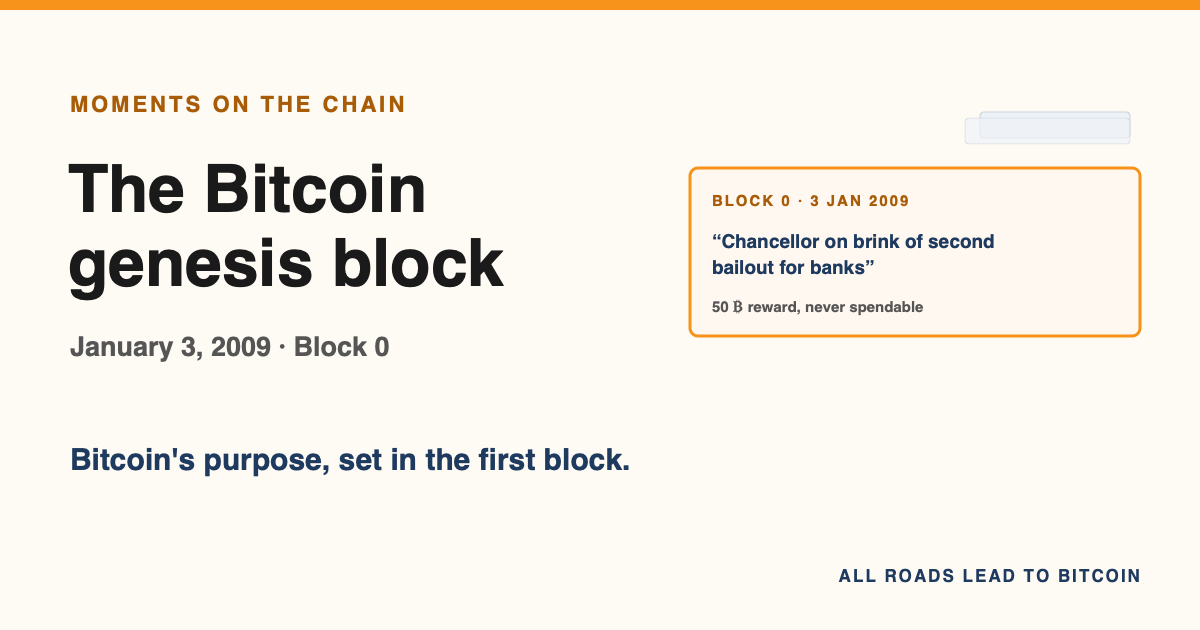
The genesis block is the first block of the Bitcoin blockchain, mined by Satoshi Nakamoto on January 3, 2009, and it has a newspaper headline buried inside it: “Chancellor on brink of second bailout for banks.” The line proves the block could not have been made earlier, the way a person holds up a dated paper in a ransom photo. But Satoshi could have used anything for that, and chose a bank bailout, putting it at the foundation of a money made to run without banks.
A headline hidden in the first block
Every block in Bitcoin has a small space where the miner can write a few bytes of arbitrary text. In the genesis block, the first block Satoshi ever mined, that space holds a headline: “The Times 03/Jan/2009 Chancellor on brink of second bailout for banks.” It is a real front page, from the London newspaper The Times, printed on January 3, 2009, during the financial crisis. Anyone can read it straight out of the raw block today, more than a decade and a half later, exactly as Satoshi left it.
On its face, the line does a plain job. It stamps the block with a date. The text of a specific morning’s paper could not have been known before that morning, so its presence proves the chain did not secretly begin weeks or months earlier.
A timestamp that is also a reason
If Satoshi only needed to prove a date, any headline from that paper would have served. Satoshi reached past the sports and the weather and chose the one about a government preparing to rescue its banks a second time. In January 2009, that was not an abstract worry. Banks had collapsed, and the response in most major economies was the same, governments and central banks printed money and propped them up. Savers watched the value of their own money erode as that new money entered the system.
Bitcoin was built as a different answer. A money no government can print more of, held directly by the people who own it, with no bank in the middle to fail or be bailed out. Putting the bailout headline in the first block reads as writing the reason into the foundation, where it can never be edited or removed. Read the block and you read the problem and the response in a single line. You can follow the same argument forward into why Bitcoin behaves as sound money, a currency whose supply no one can quietly expand.
The coins no one can ever spend
The genesis block minted 50 bitcoin, the standard reward at the time, sent to the genesis address. Those 50 coins have never moved, and they never can. When Satoshi wrote the first version of the software, the genesis block was hard-coded in a way that left its reward out of the ledger of spendable coins. Whether that was deliberate or an oversight, no one knows, but the effect is permanent.
Over the years, admirers have sent small amounts of bitcoin to that same address as a tribute. Those later coins are different from the original 50: they are ordinary, spendable outputs sitting in the normal ledger. They have never been moved either, because no one who would spend them appears to hold the key. The balance keeps climbing, watched by everyone, while only the founding 50 are frozen by the rules themselves.
The dollar in your pocket does not come with a note explaining why it exists or what it is meant to fix. Its history sits in the archives of central banks, out of sight. Bitcoin put a dated newspaper headline about failing banks at the base of its ledger instead, in public, whatever was on its founder’s mind.
What the genesis block still says
The genesis block existed, but nothing moved yet. Nine days later Satoshi sent the first coins to Hal Finney, and Bitcoin went from a running program to a working network. You can follow that step in the first bitcoin transaction. But the genesis block came first, and it set the terms. Before a single coin changed hands, Bitcoin had already said what it was for.
People still point at the headline because it anchors every argument about what Bitcoin is supposed to do. A skeptic can dismiss the price and the noise, but the founding block mentions neither. It mentions a government rescuing its banks with other people’s money, and offers a different arrangement, coins no authority can print and no bank can hold for you.
Most currencies keep their reasons in an archive. Bitcoin carved its reason into the first block.All Roads Lead to Bitcoin
Keep going
The first block stated the purpose. Nine days later, the first transfer turned it into a network.
The first bitcoin transactionCommon questions
What is the Bitcoin genesis block?
The genesis block is the very first block of the Bitcoin blockchain, mined by Satoshi Nakamoto on January 3, 2009, and labeled block 0. Every block since is built on top of it. Buried inside it is a line of text taken from that day’s newspaper: “The Times 03/Jan/2009 Chancellor on brink of second bailout for banks.” The line proves the block was not created before that date, and it points at the failing banking system Bitcoin was built as an alternative to.
What does the Times headline in the genesis block mean?
The headline, “Chancellor on brink of second bailout for banks,” was the front page of The Times of London on January 3, 2009, during the financial crisis. Satoshi embedded it in the genesis block for two reasons. It works as a timestamp, since the text could not have been written before that day’s paper existed. And it states a purpose, placing a bank bailout at the foundation of a money designed to work without banks.
Can the genesis block coins be spent?
No. The 50 bitcoin created in the genesis block can never be spent. Because of the way Satoshi wrote the original software, the genesis reward was never added to the database of spendable coins, so any attempt to move it fails. Later bitcoin that admirers have sent to the genesis address is different, ordinary spendable coins that have never been moved. The original 50, alone, are frozen by the rules themselves, permanently out of reach.
When was the Bitcoin genesis block created?
The genesis block was mined on January 3, 2009, timestamped 18:15:05 in universal time. The next block, block 1, did not appear until January 9, so there is a six-day gap at the very start of the chain. Bitcoin’s first ordinary transfer, from Satoshi to Hal Finney, came a few days after that, on January 12.
Who created the Bitcoin genesis block?
Satoshi Nakamoto, Bitcoin’s pseudonymous creator, mined the genesis block alone on January 3, 2009, before anyone else was running the software. The choice of newspaper headline, the unspendable reward, and the six-day pause before block 1 were all Satoshi’s. Who Satoshi actually was remains unknown.
Read the first block and the argument is already there, older than the price, older than the first transfer. A government rescuing its banks, and beside it a proposal for a different kind of money.
Further reading
The primary sources behind the claims here, for anyone who wants to check them directly.
- The genesis block, Bitcoin Wiki. The block 0 timestamp, the exact coinbase text, the address, and why the reward is unspendable.
- Block 0 on a block explorer. The live genesis block, with the embedded headline readable in the raw coinbase data.
- Bitcoin: A Peer-to-Peer Electronic Cash System, Satoshi Nakamoto, 2008. The design published weeks before the genesis block was mined.
- Chancellor on brink of second bailout for banks, The Times, January 3, 2009. The original front page Satoshi quoted.
Everything on this site is for educational purposes only. It is not financial, investment, tax, or legal advice. Bitcoin carries real risk. Prices move, sometimes sharply. Do your own research, think for yourself, and speak with a qualified professional before acting on anything you read here.