
The first Bitcoin transaction
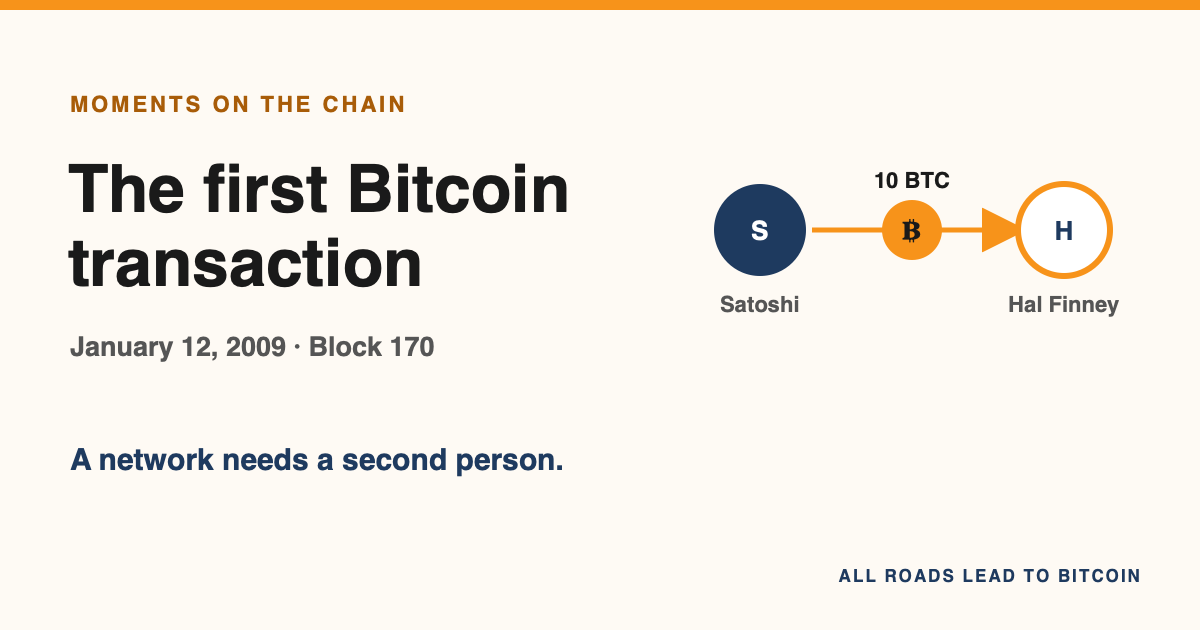
On January 12, 2009, in block 170, Satoshi Nakamoto sent 10 bitcoin to Hal Finney, the first time bitcoin ever moved from one person to another. The Genesis block nine days earlier had created coins, but Satoshi mined those alone, and they went nowhere. The first transfer is the one that turned it into a network. Money only works if someone else will take it, so a currency is only real once at least two people hold it. This was the day Bitcoin first moved between two people, and stopped being one person’s software.
Nine days that turned a program into a network
On January 3, 2009, Satoshi Nakamoto mined the first block and Bitcoin existed, in the narrow sense that the software was running. For nine days it ran mostly alone. Then a cryptographer named Hal Finney downloaded it, started it on his own computer, and on January 11 posted a two-word message that people still quote: “Running bitcoin.” He was one of the first people other than the creator to run it.
The next day, January 12, 2009, Satoshi sent him 10 bitcoin. The block is timestamped January 12 in universal time, which was late on January 11 in United States time zones, so you will see both dates depending on where you check. The transfer sits in block 170, and you can still read it on any block explorer today under the transaction beginning f4184fc5. Underneath, the mechanics were plain. Satoshi spent 50 coins he had mined earlier as the input, 10 went to Hal, and 40 came back as change. The test could not have been simpler. Could the coins move from one person to another? They could.
Why the first bitcoin transaction matters more than the first block
The Genesis block gets most of the attention, and it earned it, with the newspaper headline Satoshi buried inside it. But a single computer keeping its own ledger has not proven much, just one person writing numbers in a book only they can see. The real question was never whether Satoshi could send himself coins. What mattered was whether anyone else could receive them and agree they were real.
Block 170 settled it. Hal Finney was running his own copy of the software on his own machine, checking the rules for himself, beholden to no one. When the 10 coins arrived and his node accepted them, two independent computers agreed on a single history without a bank, a company, or a middleman to referee it. That agreement between strangers, moving value peer-to-peerA network where computers connect directly to one another and pass data along, with no central server in between. Bitcoin relays transactions and blocks peer to peer, so there is no middleman to shut down. with no one in charge, is the invention itself. The pizza, the exchanges, and the later fortunes are all that first agreement, repeated at scale.
Hal Finney, the second believer
Hal Finney was not a random early adopter. He had spent decades on the exact problem Bitcoin was built to solve. He was one of the developers of PGP, the encryption that let ordinary people keep messages private, and years before Bitcoin he had built an experimental form of digital cash of his own, called reusable proof of work, an early attempt at money you could spend online without a bank. When Satoshi published the Bitcoin white paper in October 2008, Finney was one of the few people equipped to understand it and one of the first to reply. So when he wrote “Running bitcoin,” it carried weight. Someone who knew exactly how hard this problem was had looked at the design and decided to run it.
In 2009, the same year he received the first transfer, Finney was diagnosed with ALS. He kept writing and coding as the disease advanced. In 2013 he posted a piece called “Bitcoin and me,” recounting these early days from his wheelchair, typing through an eye-tracker, still holding the coins. He died in 2014. What he left is the first proof that Bitcoin was more than one person’s idea. A creator can believe anything about their own creation. It takes a second person to make it real.
Every currency rests on one assumption: that someone else will take it from you. A dollar is only useful because the next person accepts a dollar. On January 12, 2009, Satoshi tested that assumption with the smallest experiment available, sending value to the one other person who believed the system was real. It worked. Everything Bitcoin has done since, every payment made by millions of people, is that same act scaled up.
What the first transaction still teaches
There is a clean line running through Bitcoin’s first year and a half. On January 3, 2009, it was born. On January 12, value moved across it for the first time, from Satoshi to Hal Finney. Sixteen months after that, on Bitcoin Pizza Day, it became money in the everyday sense, when someone traded 10,000 coins for two pizzas and proved it could buy a real thing. Each step added a person willing to accept the coins for something. A currency comes to life exactly this way, nothing more mystical than people, one at a time, agreeing to take it.
Most people start with the price. But Bitcoin’s value was there in block 170, before any price existed, in a form you could not put a number on, in the plain fact that a second person would take the coins. If you want the simplest version of what that thing even is, start with bitcoin in its simplest form, and you keep arriving back at the same place, money you can hand to someone else without asking anyone’s permission. On January 12, 2009, that had happened exactly once.
Every currency is a bet that other people will accept it. On January 12, 2009, Bitcoin won that bet for the first time.All Roads Lead to Bitcoin
Keep going
The first transfer made Bitcoin a network. Sixteen months later, a lunch made it money.
The story of Bitcoin Pizza DayCommon questions
What was the first Bitcoin transaction?
The first bitcoin transaction was recorded in block 170 on January 12, 2009, when Satoshi Nakamoto sent 10 bitcoin to Hal Finney, the first time bitcoin moved from one person to another. The Genesis block nine days earlier had created coins, but those were mined by Satoshi alone and never sent anywhere. Block 170 was the first transfer between two people, which is the moment the software started behaving like a network.
Who was Hal Finney?
Hal Finney was a cryptographer and early cypherpunk who helped develop PGP encryption and, before Bitcoin, built an experimental digital-cash idea called reusable proof of work. He was one of the first people to reply to the Bitcoin white paper, among the first to run the software, and the person who received the first bitcoin transfer. The day before, on January 11, 2009, he posted the tweet “Running bitcoin.” He was later diagnosed with ALS and died in 2014.
What is the “Running bitcoin” tweet?
On January 11, 2009, Hal Finney posted a two-word message, “Running bitcoin,” noting that he had downloaded and started the software. The message is one of the most quoted moments in Bitcoin’s history, because it marks the point where someone other than the creator was running the network. The day after the tweet, Finney received the first bitcoin transfer from Satoshi Nakamoto.
Was the Genesis block the first Bitcoin transaction?
No. The Genesis block, mined on January 3, 2009, created the first 50 bitcoin, but that was a mined reward to Satoshi Nakamoto, and by a quirk of the software those particular coins can never be spent. Nothing was sent to anyone. The first actual transfer of bitcoin between two people happened nine days later in block 170, when Satoshi sent 10 bitcoin to Hal Finney.
How much was 10 bitcoin worth in 2009?
There was no established price for bitcoin in January 2009, so the 10 bitcoin had no market value in dollars at the time. No exchange existed and no one had traded bitcoin for money yet. The first published exchange rate did not appear until October 2009, when one US dollar was quoted at about 1,309 bitcoin. The value of the first transfer was never the dollars involved, because there were none. It proved that bitcoin could move from one person to another at all.
The Genesis block proved bitcoin could exist. Block 170 proved it could move. The two are nine days apart, and the second is where the network first did the one thing it was built to do, carry value from one person to another, in a 10-coin transfer between a pseudonymous creator and one of the first people who believed him.
Further reading
The primary sources behind the claims here, for anyone who wants to check them directly.
- The first transaction, block 170, on a block explorer. The 10-bitcoin transfer to Hal Finney, still readable on the public ledger.
- Bitcoin and me, Hal Finney, BitcoinTalk, 2013. His own account of the early days, the first transfer, and running the software from the start, written while living with ALS.
- Bitcoin: A Peer-to-Peer Electronic Cash System, Satoshi Nakamoto, 2008. The design Hal Finney read, replied to, and chose to run.
- The Genesis block, Bitcoin Wiki. Details on the January 3, 2009 first block, its embedded headline, and why its coins cannot be spent.
Everything on this site is for educational purposes only. It is not financial, investment, tax, or legal advice. Bitcoin carries real risk. Prices move, sometimes sharply. Do your own research, think for yourself, and speak with a qualified professional before acting on anything you read here.