
What Is a Hard Fork?
A hard fork is a change to a blockchain’s rules that is not backward compatible, so any node that does not upgrade can end up on a separate chain. Anyone can copy Bitcoin’s open-source code and launch a fork, but a fork only becomes a real, lasting network if users, node operators, and the wider economy choose to run it. That’s why forking Bitcoin is easy and changing Bitcoin is hard. The rules live with the people who run the software, not with whoever writes it.
Start with the word “fork”
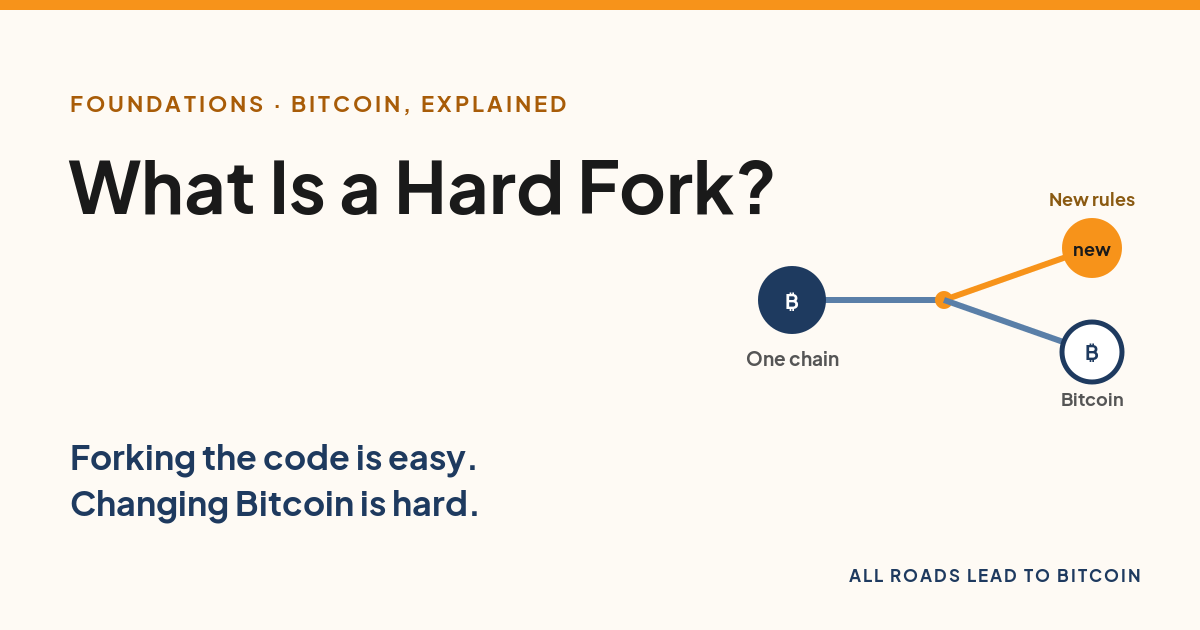
If you’re new to this, the word sounds more dramatic than it is. A fork is what happens when a blockchain’s software or rules diverge. Picture a road that splits into two. Everyone was travelling together, and now there’s a choice of paths. Most of the time the whole network takes the same path and nothing splits at all. Sometimes a group takes the other road, and from that point on there are two separate networks.
There are two kinds, and the difference comes down to one idea, whether the new rules still get along with the old ones.
Soft fork and hard fork, in plain terms
A soft fork tightens the rules in a backward-compatible way. Nodes that do not upgrade still accept the new blocks, because anything valid under the stricter rules is also valid under the old ones. The network stays as one chain. SegWit, activated in 2017, is a soft fork.
A hard fork changes the rules in a way that is not backward compatible. Blocks that are valid under the new rules are rejected by nodes running the old software, and the reverse is true too. If everyone upgrades together, the chain simply moves forward under the new rules. If they do not, the chain can split into two networks and two coins that share the same history up to the moment of the split. That shared history is the defining feature of a chain hard fork. Balances that existed on the chain at the split block exist on both chains afterward.
If that last part is fuzzy, hold onto one plain version of it. A hard fork can split the network, but only if enough people refuse to travel together.
Copying the code is not the same as forking the chain
Here’s a distinction that trips up almost everyone, and it’s worth getting straight early. There are two different things people mean when they say someone “copied Bitcoin.”
The first is launching a brand-new coin from copied software. Litecoin is the classic example. In 2011, Charlie Lee took Bitcoin’s code, changed a few things (a different mining algorithm, faster blocks, a larger supply cap), and started an entirely new blockchain from its own beginning. Litecoin shares no history with Bitcoin. Nobody who held bitcoin received any litecoin. It’s a separate network that happens to descend from the same source code.
The second is a chain hard fork, where an existing network splits. Bitcoin Cash is the classic example of that. In August 2017, a group that wanted larger blocks forked the actual Bitcoin chain. Bitcoin holders with coins recorded on the chain at the fork block had matching balances on the new chain, because the two chains shared history up to the split.
Both are versions of the same idea. Anyone can copy Bitcoin. Neither one displaced it. Keep that pattern in mind, because it repeats.
Who actually decides which chain wins
When a chain splits, which side is Bitcoin? Not the developers, not the miners, and not whoever argues loudest online. When two rule sets exist side by side, no single group gets to declare which one is Bitcoin. It comes down to which rules the network’s participants choose to run, and which chain the wider economy actually uses.
Miners provide security, but their economic incentives depend on which chain has value and demand. Developers can propose a change. They cannot make everyone else run it. A change to Bitcoin only becomes a change to Bitcoin if enough of the network adopts it. This is the same point the myth about miners controlling Bitcoin gets wrong.
That’s why a fork can succeed technically and still fail. Launching a chain proves that the software works. It doesn’t prove that the market, the users, or the broader Bitcoin economy will follow it.
The hard forks that came before
The clearest way to see this is to look at what happened every time someone tried to change Bitcoin’s core rules.
The Block Size Wars, roughly 2015 to 2017, were a long dispute over whether to make Bitcoin’s blocks bigger so each one could hold more transactions. Several efforts tried to force the change through new software: Bitcoin XT in 2015, then Bitcoin Classic and Bitcoin Unlimited in 2016, and finally SegWit2x in 2017. Each tried to get enough of the network to adopt larger blocks. Each failed to move Bitcoin. SegWit2x, the most serious of them, was called off in November 2017 for lack of agreement.
Bitcoin Cash arrived when that side ran out of room. Unable to change Bitcoin, the big-block camp did the one thing left to them and forked off. Bitcoin Cash split from Bitcoin on August 1, 2017, with larger blocks, and became a separate coin with its own market. A separate coin, as the altcoins are not Bitcoin myth explains, is exactly that. Separate.
Bitcoin SV came next. In November 2018, Bitcoin Cash itself split over an internal disagreement, producing Bitcoin SV. It was a fork of a fork.
Bitcoin Cash and Bitcoin SV are both still running today, but neither displaced Bitcoin. Bitcoin remains far larger than either fork.
In 2016, after a large hack drained a project called The DAO, Ethereum’s community chose to hard-fork and rewrite the ledger to reverse the theft, at block 1,920,000. The chain split into Ethereum, which reversed the hack, and Ethereum Classic, which kept the original history. Ethereum showed that a community can choose to make a controversial change and keep the resulting chain as the dominant one. Bitcoin has never used a hard fork to rewrite its ledger the way Ethereum did with the DAO. That difference isn’t an accident. It’s close to the whole point of Bitcoin’s rigidity.
What a hard fork actually tells you
Strip away the noise and a hard fork is a stress test of one question. Who controls the rules?
If Bitcoin were controlled by its developers, they could change it, and the changes would stick. If it were controlled by miners, the chain with the most mining power would always win. Neither is what happens.
The history tells the same story. Developers can propose changes. Miners can signal support. Businesses can back one chain over another. None of them can force everyone else to follow.
The thing that makes Bitcoin frustrating to would-be reformers is the same thing that makes it dependable to everyone else. No single group can rewrite the rules you’re relying on. Forking the code is free. Changing Bitcoin is a different matter entirely.
Forking the code is free. Changing Bitcoin is a different matter entirely.All Roads Lead to Bitcoin
Keep going
If a fork cannot change Bitcoin, then who sets the rules at all? The answer is the same reason Bitcoin is so hard to change.
Do miners control Bitcoin?Common questions about hard forks
What is the difference between a soft fork and a hard fork?
A soft fork tightens the rules in a backward-compatible way, so the network stays as one chain even if some nodes do not upgrade. A hard fork changes the rules in a way that is not backward compatible, so nodes running the old and new rules can reject each other’s blocks, which can produce a chain split if the network does not upgrade together.
Is Litecoin a hard fork of Bitcoin?
No. Litecoin was created in 2011 by copying and modifying Bitcoin’s software and launching a brand-new blockchain from its own beginning. It shares no transaction history with Bitcoin, and Bitcoin holders never received any Litecoin. Bitcoin Cash, by contrast, was a true chain hard fork of Bitcoin.
If someone forks Bitcoin, do I lose my bitcoin?
No. In a chain hard fork, the new chain inherits the history of the old one, so balances recorded at the fork block exist on both chains. Whether you can access the new-chain coins depends on how and where you hold your bitcoin and whether the relevant service supports the fork. Your bitcoin on the original chain does not disappear.
Who decides which chain is Bitcoin after a fork?
No single group. Not the developers, not the miners, and not whoever argues loudest. When two rule sets exist side by side, the outcome comes down to which rules the network’s participants choose to run and which chain the wider economy actually uses. Developers can propose a change, but they cannot make everyone else run it, so a change to Bitcoin only takes hold if enough of the network adopts it.
A hard fork looks like a moment of danger, a network about to break in two. Read the history and it turns into something steadier. Anyone can fork the code, and people have, from every direction. None of it moved Bitcoin, because moving Bitcoin takes the agreement of the people who run it, and that agreement is exactly what no developer, miner, or business can manufacture. That’s the same reason we test every claim on this site against first principles rather than authority. You can see how we think here.
Further reading
Where to go deeper on the history and the ideas behind it.
- The Blocksize War, by Jonathan Bier. The definitive inside account of the 2015 to 2017 fight over Bitcoin’s rules, and the best record of why the change never took hold.
- The Bitcoin Standard, by Saifedean Ammous. A monetary-history argument for why hard-to-change money matters.
- Broken Money, by Lyn Alden. A broader history of monetary systems and the trade-offs created by different forms of money.
- Hard Fork Completed, Ethereum Foundation, 2016. The primary record of the DAO hard fork at block 1,920,000, the counterexample to Bitcoin’s rigidity.
- The Bitcoin myths, explained. The full series this piece sits alongside.
Everything on this site is for educational purposes only. It is not financial, investment, tax, or legal advice. Bitcoin carries real risk. Prices move, sometimes sharply. Do your own research, think for yourself, and speak with a qualified professional before acting on anything you read here.