
Three Questions to Ask About Any Money: Verifying Bitcoin, Gold, and the Dollar
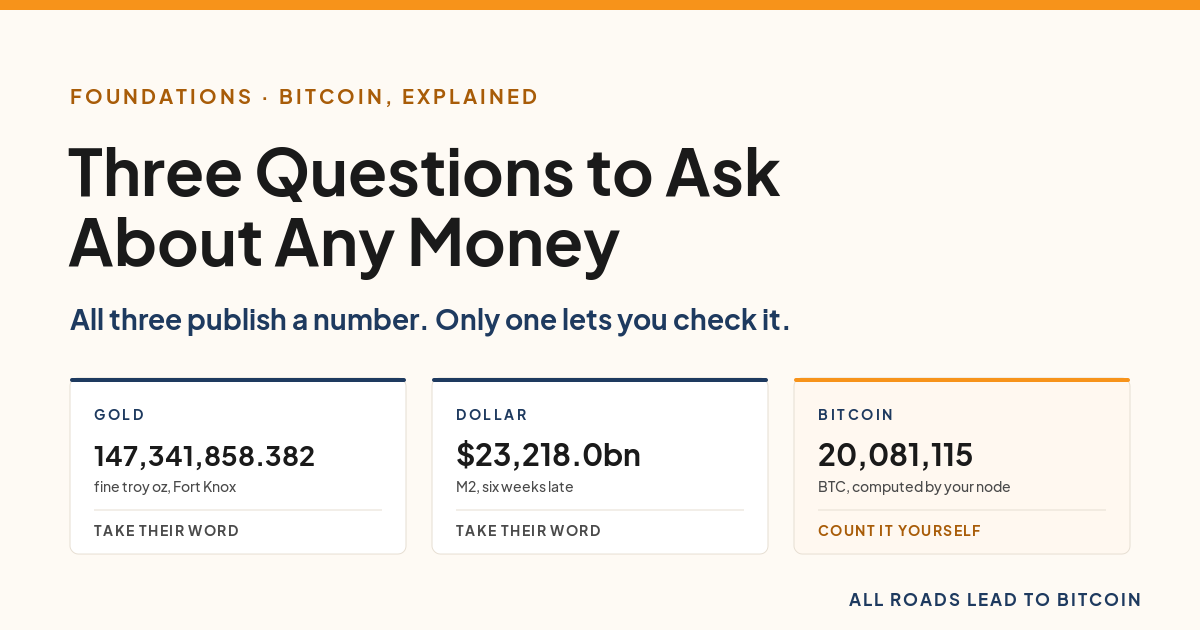
Ask three things about any money you hold. How much exists right now, how much will exist tomorrow, and whether you can answer either question yourself. Dollars and gold both have a published answer to the first question, no reliable answer to the second, and no way for you to verify either. Bitcoin is the only one of the three where the counting is something you can do rather than something you’re told.
The questions
Most arguments about money get stuck comparing things that can’t really be compared, like a five-thousand-year track record against fifteen years of uptime. A smaller set of questions works better, because anyone can put them to anything they hold and the answers can be checked.
How much of it exists right now? How much of it will exist tomorrow? And can you find out either of those things without asking someone to tell you?
The third question is the one that does the work, and it’s the one almost nobody asks. We’re used to treating a published figure as a settled fact. It usually isn’t. It’s a claim made by an institution, and the interesting question is what happens if you want to test it.
Run those three questions against the dollar, against gold, and against Bitcoin, and the results don’t line up the way either side of the argument usually claims. All three publish a number. Only one of them hands you the tools to count it yourself.
The dollar: a number, six weeks late
The Federal Reserve does publish how many dollars exist. The release is called H.6, Money Stock Measures, and it reports M1 and M2, the standard measures of the money supply. As of the release dated 25 August 2026, seasonally adjusted M2 stood at $23,218.0 billion for the month of July.
Notice the dates. That figure describes July and appeared at the end of August. Anyone reading it in early September is looking at a picture of the money supply roughly six weeks old, and the series is revised after the fact when seasonal adjustment factors are recalculated. The reporting also got slower rather than faster: H.6 was a weekly release until 11 February 2021, and it has been monthly since 23 February 2021.
So the first question has an answer, with an asterisk about lag and revision. The second question is where it falls apart. Nobody can tell you how many dollars will exist next year, and that isn’t a criticism of anyone’s forecasting. It’s a feature of how the system works. Most of what counts as money in M2 is created by commercial banks when they make loans, so the total is the running sum of millions of independent lending decisions, sitting alongside central bank policy. There’s no schedule to consult, because there’s no schedule.
The third question doesn’t really apply. You can read the release. You cannot audit the banking system that produced it.
Gold: three decimal places, and a locked door
Gold does better on the first question than most people expect. The Treasury publishes a monthly Status Report of U.S. Government Gold Reserve, and it’s specific: 147,341,858.382 fine troy ounces at the Fort Knox Bullion Depository. Three decimal places. That’s a serious number, kept by serious people, and anyone who claims the government hides how much gold it says it has hasn’t looked.
The precision is doing something interesting, though. It looks like the output of a count, and what it actually represents is the balance of an account. Those are different things, and the gap between them is the whole subject.
The last comprehensive settlement audit of the Fort Knox gold is conventionally dated to 1953. In September 1974, after decades of a closed-door policy, the Treasury invited members of Congress and the press inside, and a special settlement was performed by a committee drawn from the General Accounting Office and the Treasury. A longer audit process then ran from 1974 to 1986, at the end of which the vault compartments were closed under official joint seals. Those seals have been inspected annually since. In 1978, reviewing the work in progress, the General Accounting Office found that the continuing audits were properly carried out and that control over the physical inventory was adequate.
None of that suggests the gold isn’t there, and this article isn’t making that argument. What it means is narrower and more useful. The published figure rests on an audit trail that has been closed to outside inspection for a working lifetime, and there’s no procedure by which a member of the public can test it. You either accept the Treasury’s accounting or you don’t. There’s no third option, and no amount of decimal places changes that.
The second question is harder still. Gold’s supply grows by roughly one to two percent a year through mining, and the total that’s ever been mined is an estimate rather than a count. The World Gold Council put above-ground stocks at about 216,265 tonnes at the end of 2024, assembled from production records, trade data, and reasonable inference. It’s careful work. It is not a tally, because no such tally is possible, and nobody knows what’s still in the ground.
The figure everyone quotes for how much gold exists, roughly 216,265 tonnes above ground at the end of 2024, is the World Gold Council’s estimate, built from mining output and trade flows going back centuries. It’s the best number available, and the people who produce it label it an estimate. There has never been an inventory.
Bitcoin: you do the counting
Bitcoin answers the three questions differently, and the difference isn’t that its numbers are published more often. It’s that the numbers aren’t published to you at all. You produce them.
A full node downloads every block ever mined and checks each one against the consensus rules before accepting it. Once it’s done that, the software can total up every coin that exists and hasn’t been spent. In Bitcoin Core the command is gettxoutsetinfo, and the field you want is total_amount, the sum of all unspent outputs. That number is calculated on your machine, from data your machine validated. Nothing is fetched from a server and nothing is taken on anyone’s word. As of the end of August 2026 the answer was about 20,081,115 bitcoin, and the twenty millionth coin was mined on 9 March 2026, in block 939,999.
The second question is where Bitcoin is unusual. Tomorrow’s supply is already known, and so is 2035’s. New bitcoin enters circulation only through the block subsidy, which started at 50 bitcoin per block and halves every 210,000 blocks. It’s currently 3.125 bitcoin, and the next halving falls at block 1,050,000, expected around April 2028. Every node checks that rule on every block. A miner who tried to pay themselves more would have the block rejected, not by an authority, but by every machine that independently disagreed.
One correction worth making, because we’d rather be right than tidy. The cap isn’t exactly twenty-one million. The subsidy is calculated in whole satoshis and gets truncated at each halving, so the schedule tops out at 20,999,999.9769 bitcoin, and the realised total lands lower again because of coins destroyed and rewards never claimed. Slightly under twenty-one million is the accurate phrasing, and the real supply cap is worth a look on its own, because every correction to the round number runs in the same direction.
| Question | Dollar | Gold | Bitcoin |
|---|---|---|---|
| How much exists now? | Published monthly, several weeks late, later revised | Published monthly for US reserves; the world total is an estimate | Computed on demand by any full node |
| How much tomorrow? | Unknown; depends on bank lending and policy | Roughly 1 to 2% a year, and nobody knows what’s underground | Fixed by a schedule already written and enforced |
| Can you check it yourself? | No | No | Yes, at the cost of some disk space and patience |
The comparison isn’t about which asset is worth more, and it says nothing about what any of them will be worth. It’s about who holds the ability to verify. On the first two questions gold and the dollar each have real answers and real limits. On the third they give the same answer, and it’s the uncomfortable one.
What checking it actually costs
Saying anyone can verify Bitcoin’s supply is true, and it slides past the price of doing so. The chain passed 767 gigabytes in September 2026 and grows by roughly twelve percent a year. Bitcoin Core’s own documentation is blunt about the first sync, saying it will take at least several days and longer on a slow connection. You can run a pruned node in about seven gigabytes of storage, which still validates every rule on every block, but pruning saves disk rather than bandwidth. The full chain still has to come down and be checked before the old blocks are discarded.
Then there’s the question of how many people bother. Roughly 26,900 nodes were reachable on 8 September 2026, meaning they accept incoming connections. That’s a floor rather than a total, since a node behind a home router validates identically and stays invisible to anyone counting. But even generous estimates of the real total sit orders of magnitude below the number of people who own bitcoin. Most holders check the supply the way they’d check anything else, by looking at a website, which is precisely the arrangement the whole design was supposed to make unnecessary.
There’s a further default worth naming. A standard Bitcoin Core node doesn’t verify every signature in history. It ships with a hardcoded block hash that several well-known developers have each confirmed as valid, and skips signature checking below that point. Supply, block structure, and recent signatures are all still checked, and the node will still abandon that block for a higher-work valid chain, so it isn’t a checkpoint in the old sense. But the out-of-the-box sync does lean on developer attestation for old signatures, and you have to switch it off yourself to verify everything. The claim survives, with the caveat attached.
The year the check was broken
Bitcoin’s verification has already failed once, in a way most writing on the subject skips over.
In September 2018, Bitcoin Core disclosed CVE-2018-17144. An optimisation added in version 0.14 had removed a check that a transaction didn’t spend the same input twice, leaving the case caught only by an internal sanity assertion. In version 0.15 that assertion was subtly weakened during unrelated work. The result was that versions 0.15.0 through 0.16.2 could accept a block containing a double-spend of an output created in an earlier block, which would have let a miner inflate the supply.
For roughly a year, most of the network was running software that would have accepted invalid inflation had anyone produced it. The nodes were validating. They were validating wrongly.
It was never exploited on the main network. A developer working under the name Awemany found it on 17 September 2018 and reported it as a denial-of-service bug; Matt Corallo identified the inflation implication within three hours, and a fix shipped the following day, with full disclosure on 20 September. After that disclosure the bug was demonstrated on the test network, where affected nodes did accept the invalid spend and had to be recovered by hand. The failure mode was real, not theoretical.
Nothing about the protocol caught CVE-2018-17144. A developer reading open-source software did, and the fix was public within a day. That’s the difference the three questions are pointing at. Bitcoin’s verification can fail, and when it does, anyone with the patience to read the code can find the failure and prove it. No equivalent path exists into a sealed vault or a bank’s balance sheet.
It would be easy to file that story under embarrassing history and move on. It’s more useful the other way round. Every system that claims to be checkable will eventually be checked and found wrong about something, and what matters is what happens next. This one was found by an outsider reading published source code, disclosed within seventy-two hours, patched, and documented in detail that anyone can still read today. Compare that with what a member of the public can do about a discrepancy in a gold vault, or in the deposit records of a commercial bank.
What the questions are for
None of this settles which money is better, and it isn’t meant to. Gold has a track record Bitcoin can’t match and an industrial demand floor Bitcoin doesn’t have. Dollars pay taxes and buy groceries. Those are real advantages and the case that gold is superior to Bitcoin rests on several of them.
What the three questions give you is a habit rather than a verdict. Applied to anything you’re offered, they separate what an institution asserts from what you’re able to confirm, and that distinction survives long after any particular argument about assets has gone stale. It works on a savings product, a stablecoin, an exchange claiming to hold your coins, or a company’s reserve figures. Ask what the number is, ask who produced it, and ask what you’d have to do to check.
Bitcoin’s answer to the third question is unusual, and it’s also demanding. It hands you the ability to verify and then asks you to actually do it, on your own hardware, over several days, having first understood what you’re looking at. Most people won’t, which is a genuine limit on the argument rather than a footnote to it. But the option existing at all is new, and it’s the property most worth protecting. That’s the standard we hold every claim to here, and you can see how we think for yourself.
The number is the smaller question. Who gets to check it is the larger one.
Keep going
Verifiability is one of the qualities the gold comparison turns on. The full argument, including where gold still wins, is worth reading next.
Is gold superior to Bitcoin?Common questions
How can anyone verify how much Bitcoin exists?
By running Bitcoin Core and calling the gettxoutsetinfo command, which returns the total value of all unspent outputs. The figure is computed from the copy of the chain your own machine downloaded and validated, not fetched from a server. Checking it takes a few hundred gigabytes of disk and several days of initial syncing, and the software is free.
Has the gold at Fort Knox ever been audited?
Yes, though not in full for a long time. The last comprehensive settlement audit is conventionally dated to 1953. A partial special settlement was performed by the General Accounting Office and the Treasury in 1974, and a longer audit process ran from 1974 to 1986, after which the vault compartments were closed under joint seals that are inspected annually. The Treasury publishes the tonnage monthly. What no member of the public can do is verify it independently.
Does the Federal Reserve publish how many dollars exist?
Yes. The H.6 Money Stock Measures release reports M1 and M2. It was published weekly until February 2021 and has been monthly since. The figures arrive with a lag of several weeks and are subject to revision. The Federal Reserve does not directly control the total, because most of what counts as money is created by commercial banks when they lend.
Go deeper
- Broken Money, by Lyn Alden. How money evolved alongside technology, and why settlement and verification sit at the centre of it.
- The Bitcoin Standard, by Saifedean Ammous. The monetary-history case for hard money, and the properties that decide which money people keep.
- Bitcoin’s real supply cap. The companion piece on what “21 million” rounds away, and why the rounding runs against Bitcoin.
- Money is a competition. The companion argument about what actually stands behind Bitcoin, gold, and the dollar.
- Bitcoin has no intrinsic value. The objection that usually follows once backing has been set aside.
- The Bitcoin myths, explained. The full series this deep-dive sits alongside.
Everything on this site is for educational purposes only. It is not financial, investment, tax, or legal advice. Bitcoin carries real risk. Prices move, sometimes sharply. Do your own research, think for yourself, and speak with a qualified professional before acting on anything you read here.