
Bitcoin in its simplest form
Bitcoin is digital money that runs on a shared public record instead of a bank, with a supply capped at 21 million that no one can change. You hold it with a secret key, so no company can freeze it or print more of it. Understanding it takes three ideas, a record everyone shares, a key only you hold, and a network that enforces the rules. This is education, not financial advice.
Start with what money actually is
Bitcoin feels complicated because most explanations start in the middle, with mining rigs and cryptography. Start earlier and it gets simple. Ask what money is in the first place. It is not the paper or the metal. Money is a tool people invented to hold value, move it around, and measure the worth of everything else. Across history that tool has been shells, salt, cattle, silver, and gold, and eventually paper notes printed by governments.
Each of those worked as money for one reason. Enough people agreed to accept it. That’s the whole trick. A thing becomes money when enough people willingly accept it in exchange. Once you see money as an agreement rather than an object, Bitcoin stops looking strange. It is a new candidate for the same old job, built for a world where value moves over the internet.
The problem Bitcoin was built to answer
The money in your bank app has two features most people never think about. The first is that its supply can grow. Since 1971, when the United States ended the dollar’s link to gold, the world has run on fiatGovernment-issued money that is not backed by a physical commodity like gold. It holds value because the government declares it legal tender and people accept it. money, which holds value because a government declares it does. Central banks can create more of it, and when they do, each existing unit tends to buy a little less. That slow loss of purchasing power is inflation, and it is the reason a dollar today buys less than a dollar did twenty years ago.
The second feature is quieter. The balance in your account is not, in the strict legal sense, cash you hold. It is a claim on the bank, which can freeze it, limit it, or fail while holding it. For most people, most of the time, this is invisible and fine. Bitcoin was built for the moments when it is not, and for anyone who would simply rather hold money that cannot be printed and cannot be frozen. It was released in 2009, just after a financial crisis made both problems hard to ignore.
What Bitcoin actually is
Here is Bitcoin stripped to its frame. Picture a public ledger, a running list of every transaction ever made, that lives on thousands of computers around the world at once. Each computer holds the same copy, and they constantly check each other. That shared record is the blockchainThe shared public ledger of all Bitcoin transactions, maintained by every node and ordered into linked blocks.. There is no master copy in a head office, because there is no head office. This is what people mean by decentralizationControl spread across many independent participants instead of held by one authority, so no single party can change the rules, seize funds, or shut the network down..
Because no one runs it, no one can change its rules on a whim. The 21 million limit holds not because a bank promises to honor it, but because every computer on the network would reject any attempt to break it. That is the quiet radical part. Digital files normally copy perfectly, so making a digital unit that cannot be spent twice, with no central authority policing it, had never been solved before Bitcoin. Bitcoin is the first widely used digital money whose scarcity is enforced by the network’s rules rather than by a central issuer, and the deeper case for where bitcoin has value starts right here. If you want the mechanics of why no one can seize or overrule it, that is the subject of bitcoin decentralization and security.
How Bitcoin moves, in plain language
When you send bitcoin, nothing physical travels. What happens is closer to updating a shared spreadsheet that no one can secretly edit. You prove the right to spend by signing the transaction with your private keyA secret cryptographic number that proves the right to move bitcoin from an address. Whoever holds it controls the bitcoin., a secret number that only you hold. The network then checks that the key is valid and that you actually have the funds, and if it does, the transaction is added to the record.
The computers that do this checking and bundle transactions into the ledger are called miners, and the process that secures it is proof of workA consensus rule where miners spend real energy to add blocks, making the chain’s history expensive to rewrite., where real energy is spent to make the record expensive to fake. You do not need to run any of that to use Bitcoin, any more than you need to understand the card networks to tap a debit card. The useful picture is just the three moving parts. Your key signs, the network verifies, the shared record updates.
A common way to picture Bitcoin is a giant notebook copied onto thousands of computers, where every payment gets written down. The reason that matters is the copies. To fake a transaction, you would have to change the notebook on the majority of those machines at the same moment, all of which are watching each other and rejecting anything that breaks the rules. A bank’s ledger sits on the bank’s servers, and you trust the bank not to alter it. Bitcoin’s ledger is held by everyone, so it does not depend on trusting any one keeper.
Why the simple design is the whole point
Once the frame is clear, the features stop sounding like marketing and start sounding like consequences. The supply is capped at 21 million, so no one can dilute what you hold by making more. You can hold it yourself with your own key, so no company sits between you and your money. And a single bitcoin divides into 100 million satoshiThe smallest unit of Bitcoin, one hundred-millionth of a bitcoin (0.00000001 BTC). Named after Bitcoin’s pseudonymous creator., so you never have to buy a whole one. A few dollars buys a few thousand sats, which is why you do not have to buy a whole bitcoin to begin.
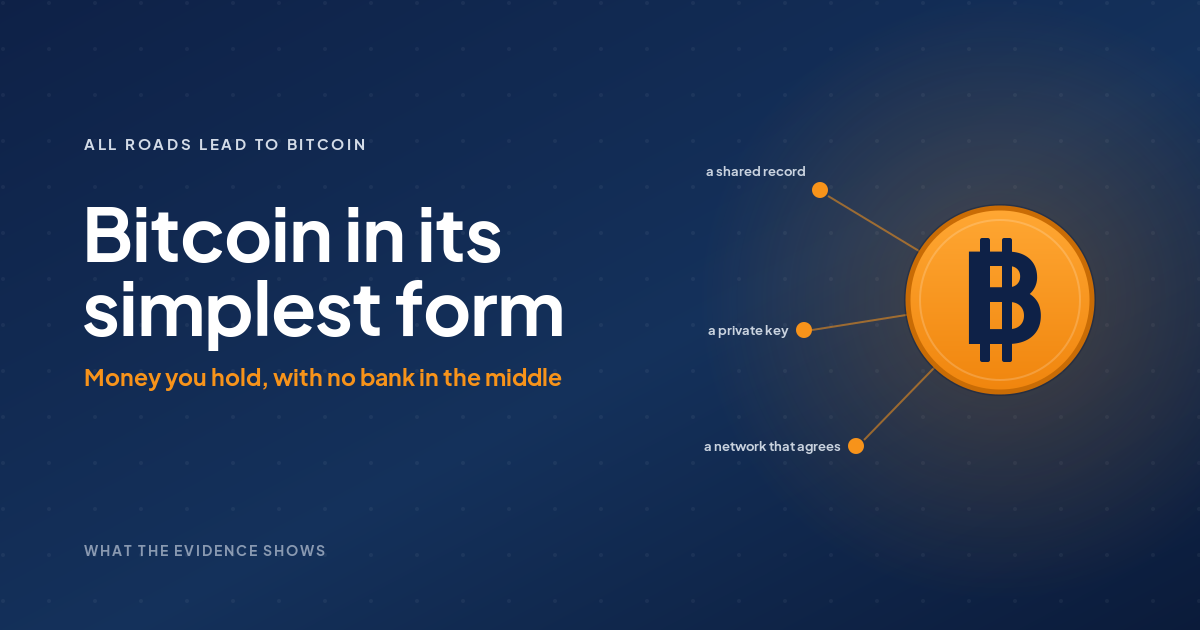
None of this requires you to become technical. It asks you to hold one picture in your head: a shared record, a private key, and a network that agrees. A debit card hides a tangle of banks and clearing houses behind a simple tap. Bitcoin hides its machinery too, but what it hides is simpler and more honest, a rulebook anyone can read and no one can quietly change. When you are ready to act on it rather than just understand it, the practical on-ramp is the bitcoin beginners guide.
Bitcoin is not complicated money made simple. It is simple money that the modern world had forgotten was possible.All Roads Lead to Bitcoin
Keep going
You know what it is. The next question is where its value comes from.
Why does bitcoin have value?Common questions
What is Bitcoin in the simplest terms?
Bitcoin is money you can hold and send yourself, with no bank or company in the middle. It lives as entries on a shared public record that thousands of computers keep in sync, and only the holder of a secret key can move any of it. Its supply is capped at 21 million, a rule no government or company can change. That combination, money you fully control on a network no one owns, is what makes it different from the money in a bank app.
What backs Bitcoin if it is not backed by gold or a government?
Nothing physical backs it, and nothing backs most modern money either. The dollar has not been redeemable for gold since 1971. What gives Bitcoin value is a fixed supply that no one can inflate, the work and energy that secure its record, and the growing number of people who accept it. It is money whose scarcity is guaranteed by math and code rather than by a promise from an institution.
Do I need to buy a whole bitcoin?
No. One bitcoin divides into 100 million smaller units called satoshis, so you can buy and hold any fraction you like. Most people start with a small amount to learn the process. Owning a slice of a bitcoin is completely normal and works exactly the same as owning a whole one.
Is Bitcoin real money?
It does the jobs money does. It stores value, it can be sent and received, and a growing number of people and businesses accept it. It is young, so its price still moves more than an established currency, but the design is money in the classic sense, something scarce and hard to counterfeit that people can hold and exchange. Whether it becomes everyday money everywhere is still unfolding.
Do I have to understand the technology to use Bitcoin?
No more than you have to understand banking software to use a debit card. The useful mental model is simple, a shared record, a secret key that only you hold, and a network that enforces the rules. You can use Bitcoin well with that picture alone, and learn the deeper mechanics later if you want to.
Strip away the jargon and Bitcoin is not an exotic invention. It is an old idea, money you hold and control yourself, rebuilt for a connected world so that scarcity is guaranteed by code and no bank stands in the middle. Hold the three pieces in your head, a shared record, a private key, and a network that agrees, and you understand the thing well enough to use it. The rest is detail.
Bitcoin first proved it could work as money on one strange day in 2010, when someone spent 10,000 coins on two pizzas. That is Bitcoin Pizza Day, the first time it bought something real.
Further reading
The primary sources behind the claims here, for anyone who wants to check them directly.
- Bitcoin: A Peer-to-Peer Electronic Cash System, Satoshi Nakamoto, 2008. The nine-page paper that describes the whole design, including the 21 million limit and the shared record.
- How Bitcoin works, Bitcoin.org. A plain overview of wallets, keys, addresses, and transactions.
- Nixon Ends Convertibility of U.S. Dollars to Gold, Federal Reserve History. The record of the 1971 decision that moved the dollar off gold.
Everything on this site is for educational purposes only. It is not financial, investment, tax, or legal advice. Bitcoin carries real risk. Prices move, sometimes sharply. Do your own research, think for yourself, and speak with a qualified professional before acting on anything you read here.