
Bitcoin beginner’s guide
To start with Bitcoin, buy a small amount on a reputable exchange, learn how it works, and then move it into a wallet you control. You don’t need to understand the whole system first, and you don’t need to buy a whole coin. Begin with an amount you can afford to lose, treat the first purchase as practice, and take custody of your keys as your holdings grow. This is education, not financial advice.
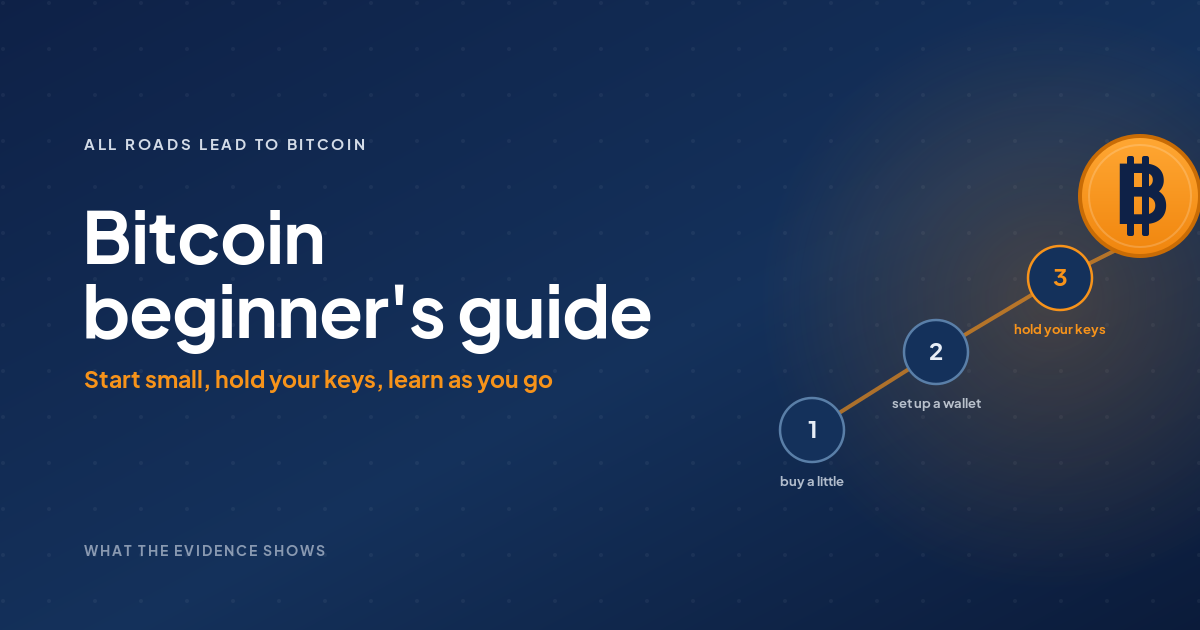
You do not need to understand everything to begin
The most common reason people put off buying their first bitcoin is the feeling that they need to understand all of it first. You do not. You only need one working picture of Bitcoin to begin. A shared record of who owns what, kept on thousands of computers, where a secret key is the only thing that can move your share. That picture is enough, and the deeper mechanics are there whenever you want them in the explainer on bitcoin in its simplest form.
This guide shows you how to get your first bitcoin, hold it so it’s yours to control, and know what to learn next without drowning in it. Take it one step at a time. There is no prize for rushing, and no penalty for starting small.
What Bitcoin is, in one breath
Here is the whole idea in three parts. There is a public ledger, a running record of every transaction, copied across thousands of computers so no one can secretly rewrite it. There is your private keyA secret cryptographic number that proves the right to move bitcoin from an address. Whoever holds it controls the bitcoin., a secret number that is the only thing able to move your bitcoin. And there is the network, which checks every transaction against the same fixed rules, including the cap of 21 million coins.
Everything else is built on those three ideas. No company needs to hold your balance, no central server can be switched off, and no one can print more to dilute what you own. If any single idea here is unfamiliar, the plain-language walkthrough in bitcoin in its simplest form covers it slowly, and the reason a fixed supply matters is the subject of bitcoin sound money.
Getting your first bitcoin
For almost everyone, the first bitcoin comes from a reputable exchange, a company that lets you convert dollars, euros, or your local currency into bitcoin after you verify your identity. Buying your first bitcoin is straightforward. The order matters more than the speed.
- Pick a well-established exchange and complete its identity verification. Choose size and track record over flashy promotions.
- Buy a small amount first. Treat this purchase as a lesson in how the process feels, not as a position to get right.
- Set up your own wallet and write down its recovery phrase on paper, by hand, storing it somewhere safe. Never type it into a website or photograph it.
- Move your bitcoin off the exchange to that wallet once you are comfortable using it, so you hold the keys rather than the company.
- Keep sensible security habits, including a strong unique password and two-factor authentication on every account involved.
Notice that the exchange is a starting point, not a home. It is the easiest place to buy and among the riskier places to store bitcoin for years, for reasons the next step makes plain.
Holding bitcoin so it is really yours
When your bitcoin sits on an exchange, it lives in a custodial walletA wallet where a third party, such as an exchange, holds your private keys for you. You hold a balance, they hold the keys., which means the company holds the keys and you hold a balance on a screen. That is fine for a small amount you are still learning with. As the amount grows into money you would be hurt to lose, moving it to a non-custodial walletA wallet where you hold your own private keys on your own device, with no third party able to move your funds. puts the keys in your hands. This is self-custodyHolding your own private keys yourself, typically on a hardware wallet, so no third party can move or freeze your bitcoin., and it is the point most beginners underrate.
The common tool for larger amounts is a hardware walletA small dedicated device that stores your private keys offline and signs transactions, keeping the keys off any internet-connected computer., a small device that keeps your keys offline in what is called cold storageKeeping your private keys completely offline, for example on a hardware wallet, beyond the reach of online attackers.. The habit you cannot skip is protecting your seed phraseA list of 12 to 24 ordinary words that backs up a wallet’s private keys. Anyone with the words can restore the wallet and spend the bitcoin., the handful of words that can restore your wallet. Write it down, store copies safely, and never share it. The stakes behind this are the whole subject of why self-custody matters.
If you remember one line from this guide, remember that one. Whoever holds the private keys controls the bitcoin. Leave your keys with an exchange and, in the way that counts, the exchange holds your bitcoin and you hold its promise to give it back. Take the keys yourself and the promise becomes the real thing. You do not have to do this on day one, and an exchange is a reasonable place to begin. Just know that taking custody is the step that turns a balance on someone’s screen into money that is only yours.
Learning as you go, without the noise
Once you own a little bitcoin, the temptation is to follow the price hour by hour and wade into the arguments online. A calmer path works better. Pick up one real question at a time, get an honest answer, and move on. Most of what stops beginners is a handful of recycled objections, and each has a grounded answer. Bitcoin’s energy use, its volatility, its association with crime, whether governments can ban it, and whether you need a whole coin are all addressed plainly in the Bitcoin myths, explained.
Two starting points settle the most common worries. The first is that you do not have to buy a whole bitcoin, so cost is never the barrier it seems. The second is that the reason to hold it at all is not a price prediction but a property, a fixed supply no one can inflate, which is the case laid out in why bitcoin has value. Learn at the pace of your own curiosity. Nothing here rewards panic.
Bitcoin does not ask you to understand everything. It asks you to understand the next thing.All Roads Lead to Bitcoin
Keep going
You have the path. If any part of what Bitcoin actually is still feels fuzzy, start with the plain-language version.
Bitcoin in its simplest formCommon questions
Is Bitcoin legal?
In most countries, yes. Many treat it as property for tax purposes, including the United States, which means selling or spending it can be a taxable event. A handful of countries restrict or ban it. Rules also change over time, so check the current law where you live before you buy. Legality in most of the world is settled; the details of tax and reporting are what vary.
How much bitcoin does a beginner need to start?
Start with an amount small enough that losing it would not hurt, because the first purchase is really about learning the process, not the size of the position. One bitcoin divides into 100 million satoshis, so any amount works. Never put in money you cannot afford to lose, and never borrow to buy. This is education, not financial advice, so treat the amount as your own decision.
Where do I buy my first bitcoin?
Most people buy their first bitcoin on a reputable exchange, which lets you convert local currency into bitcoin after verifying your identity. Pick a well-established one, buy a small amount to learn the flow, and then practice moving it to a wallet you control. An exchange is a fine place to buy and a poor place to store large amounts long term.
Do I need to hold my own keys, or can I leave bitcoin on an exchange?
Leaving a small amount on a reputable exchange while you learn is reasonable. As the amount grows into money you would be hurt to lose, moving it into your own wallet becomes worth the effort, because whoever holds the keys controls the bitcoin. The common saying, not your keys, not your coins, is the one habit worth adopting early.
What happens if I lose access to my bitcoin?
If you hold your own keys and lose both the wallet and its backup, the bitcoin is gone for good, because no one else can restore it. That is why the core task of self-custody is backing up your recovery phrase, a list of words that can rebuild the wallet, and storing copies somewhere safe and durable. If your bitcoin is on an exchange, account recovery works more like a normal login, with the tradeoff that the exchange holds the keys.
A beginner’s guide cannot make you an expert, and it does not need to. It needs to get you safely from curious to holding, with the one habit that protects you already in place. Buy a small amount, learn how it moves, take your own keys, and add understanding at the pace that suits you. Every experienced Bitcoiner started exactly where you are now.
Two things you will run into next. You will hear about ETFs and bitcoin-adjacent stocks, so it helps to know how exposure differs from actually owning bitcoin. And if you have asked an AI about Bitcoin and gotten a dismissive answer, here is why it is so often wrong.
Further reading
The primary sources behind the claims here, for anyone who wants to check them directly.
- Bitcoin: A Peer-to-Peer Electronic Cash System, Satoshi Nakamoto, 2008. The original design, including the fixed supply and the key-based ownership model.
- Getting started with Bitcoin, Bitcoin.org. A neutral overview of wallets and first steps.
- How Bitcoin works, Bitcoin.org. A plain explanation of keys, addresses, and transactions.
Everything on this site is for educational purposes only. It is not financial, investment, tax, or legal advice. Bitcoin carries real risk. Prices move, sometimes sharply. Do your own research, think for yourself, and speak with a qualified professional before acting on anything you read here.