
Why self-custody matters
Self-custody means holding your own private keys, so no third party can move, freeze, or lose your bitcoin. It matters because ownership of bitcoin is really control of a key. Whoever holds the key holds the money. Leave the key with a company and you hold a promise from that company, not the bitcoin itself. Take the key and the promise becomes the real thing. This is the why of self-custody. The practical steps of setting one up are a separate guide, and an exchange is a fine place to start. This is education, not financial advice.
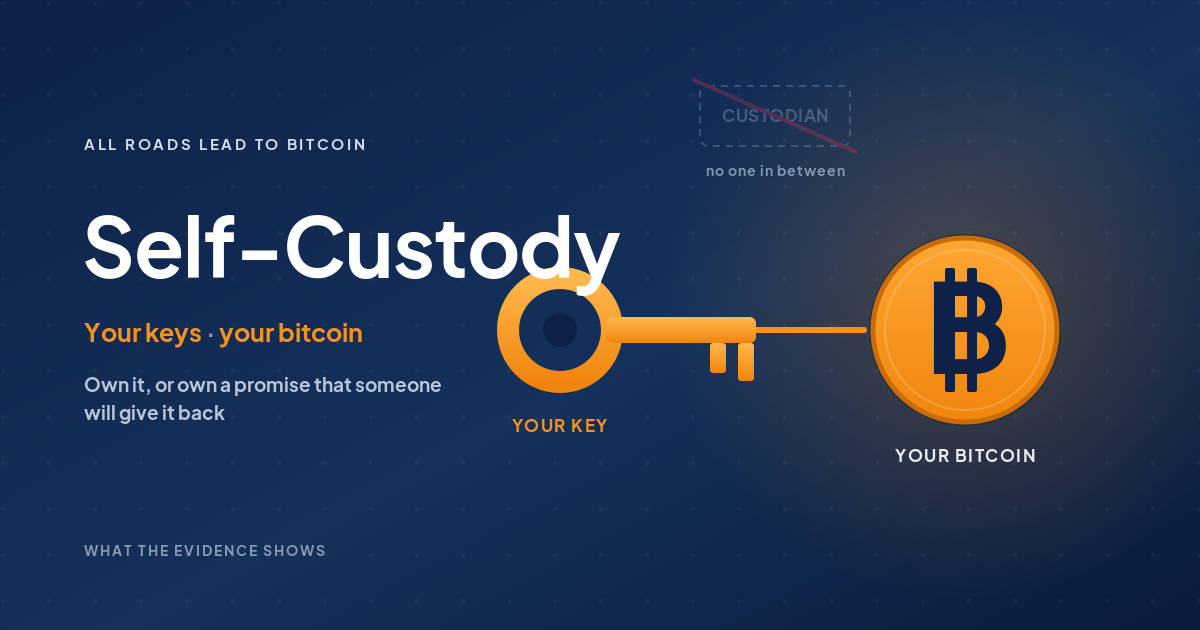
What self-custody actually means
Everything about self-custody starts with one fact. There is no coin, no file, and no object that lives on your phone or in a vault. What exists is an entry on a shared public ledger saying a certain amount of bitcoin sits at a certain address, and a rule that only one thing can move it. That one thing is a private keyA secret cryptographic number that proves the right to move bitcoin from an address. Whoever holds it controls the bitcoin., a secret number that proves the right to spend from that address.
So owning bitcoin is not like owning cash in your pocket. It is like being the only person who knows the combination to a vault no one else can open. The public addressA public identifier on the blockchain that others can send bitcoin to, like an account number. Safe to share. is the safe, visible to everyone. The private key is the combination. That’s what ownership means. Self-custodyHolding your own private keys yourself, typically on a hardware wallet, so no third party can move or freeze your bitcoin. simply means you are the one who holds that key, rather than handing it to a company to hold on your behalf. A wallet does not really store bitcoin. It stores keys, which is a different thing than the idea that bitcoin lives in your wallet would suggest. Holding your own keys isn’t new. What’s new is a global monetary network where anyone can hold their own key and use it, with no institution required.
If someone else holds the key, you hold a promise
Most people buy their first bitcoin on an exchange, and unless they move it, the exchange keeps the keys. That arrangement has a name. It is a custodial walletA wallet where a third party, such as an exchange, holds your private keys for you. You hold a balance, they hold the keys., and it means the company holds the actual keys while you hold a balance on a screen. The bitcoin represented by that balance is real, but your claim to it runs through the company. You are a counterpartyThe other party you must rely on in an arrangement. An exchange holding your keys is a counterparty; self-custody removes it. away from your own money.
This is where the most repeated line in Bitcoin comes from. Not your keys, not your coins. It sounds like a slogan, but it is a precise description of who owns what. If the keys are the thing that moves the bitcoin, and someone else holds the keys, then in every way that matters they hold the bitcoin and you hold their word. A non-custodial walletA wallet where you hold your own private keys on your own device, with no third party able to move your funds. flips that around. You hold the keys, so there is no word to trust and nothing to reclaim. The bitcoin answers to you directly. Whether your bitcoin is safe on an exchange is really this same question asked out loud.
Those promises break, and the record is long
A promise is fine until the party making it cannot keep it, and Bitcoin’s short history already holds a long list of the ones that could not. In 2014, Mt. Gox, then the largest bitcoin exchange in the world, collapsed with about 850,000 bitcoin missing, roughly 7 percent of every bitcoin that existed at the time. Some was later recovered, but customers waited a decade for even partial repayment. In 2022, FTX went from one of the most trusted names in the industry to bankruptcy in under two weeks, with billions in customer funds gone. In every one of these cases, the people who had left their keys with the company are the ones who paid.
None of these failures were breaks in Bitcoin. The network ran fine throughout. They were breaks in the companies people trusted to hold their keys, which is a different and much older kind of risk. It’s the risk you take any time your money is really someone else’s promise. The point of self-custody is not that companies are villains. It is that self-custody removes the need to find out whether this particular one is.
In 2019, QuadrigaCX, then Canada’s largest bitcoin exchange, stopped paying out. The public story was that its founder had died holding the only keys to the company’s reserves. A later review by the Ontario Securities Commission found something worse. Much of the customer money was already gone, run more like a fraud than a vault. The two explanations point at the same lesson. When a company holds the keys, you cannot see whether the bitcoin is really there. You are trusting a balance on a screen, and about 76,000 people found out at the same moment that the screen was all they had.
Bitcoin is the first money you can hold with no one in between
Why does self-custody feel like a new idea at all? For most of history, holding serious value meant trusting someone with it. Gold was sound money, but it was heavy and hard to verify, so people stored it in banks and carried paper claims, and control drifted to whoever held the vault. Bank money is convenient, but it lives on someone else’s ledger, which is why an account can be frozen or a bank can fail. Even physical cash falls short. You can hold it yourself, but you cannot check it for authenticity by eye, and you cannot send it across an ocean without a courier.
Bitcoin is the first form of money that combines both halves. You can hold it yourself, the way you hold cash, and also verify it and send it anywhere, the way you can only do through a bank. Storing keys offline in cold storageKeeping your private keys completely offline, for example on a hardware wallet, beyond the reach of online attackers., often on a dedicated hardware walletA small dedicated device that stores your private keys offline and signs transactions, keeping the keys off any internet-connected computer., gives you gold’s independence without gold’s need for a guard. This is only possible because the network underneath answers to no one, the same open design behind bitcoin decentralization and security. Self-custody is what you do with that independence, and it is inseparable from the deeper case for securing wealth you actually control.
Self-custody is the point, not a precaution
There is a real catch, and it is the whole reason self-custody asks something of you. When you hold the keys, the safety net goes too. There is no support line, no fraud department, and no password reset. Lose the keys and the backup that stands behind them, a seed phraseA list of 12 to 24 ordinary words that backs up a wallet’s private keys. Anyone with the words can restore the wallet and spend the bitcoin. of ordinary words, and the bitcoin is gone. That responsibility is real, and it is why the practical how-to of setting up and backing up a wallet deserves its own careful guide rather than a paragraph here.
But the catch and the benefit are one fact. The reason no company can reset your keys is the reason no company can freeze them. A bank can reverse a payment because a bank is in control, and that same control is what lets it close your account or comply with an order to freeze it. Self-custody gives up that safety net for something older and simpler, money that is yours because you hold it, not because someone agreed to hold it for you. Whether that trade is worth making is a personal call. What is worth seeing clearly is that self-custody is not a feature bolted onto Bitcoin for the cautious. It is the thing Bitcoin was built to make possible, and the rest is a question of when you are ready to use it.
A balance an institution holds for you is a promise someone can break. Bitcoin you hold yourself is not a promise. It is the thing itself.All Roads Lead to Bitcoin
Keep going
If self-custody is about who really holds your bitcoin, the next question is what that means while it is still sitting on an exchange.
Is your bitcoin safe on an exchange?Common questions
What does self-custody mean?
Self-custody means holding your own private keys, the secret numbers that prove the right to move your bitcoin, instead of leaving them with an exchange or other company. When you self-custody, no third party can move, freeze, or lose your bitcoin, because no third party holds the key. The trade is that the responsibility is yours too. There is no support line and no password reset, so the backup of your keys is on you.
What does not your keys, not your coins mean?
It is a plain way of saying that whoever controls the private keys controls the bitcoin. If an exchange holds the keys for you, then in practice the exchange owns the bitcoin and you own a promise from the exchange to give it back. That promise is only as good as the company behind it. Holding the keys yourself is what turns the promise into direct ownership.
Is my bitcoin safe on an exchange?
An exchange is a reasonable place to buy bitcoin and a risky place to store it long term. While your bitcoin sits on an exchange, the company holds the keys, which means your balance depends on that company staying solvent, honest, and unhacked. History has a long list of exchanges that failed on one of those counts and took customer funds with them. Buying on an exchange is fine. Leaving a large amount there for years is the part worth rethinking.
What happens if I lose my keys or seed phrase?
If you lose the keys and the seed phrase that backs them up, the bitcoin is gone for good. No one can reset it, because no one else has the keys. That is the same feature that stops anyone from seizing your bitcoin. It is why the practical work of self-custody is really the practical work of backing up a seed phrase somewhere safe and durable, which is its own step-by-step guide.
Do I need self-custody, or is an exchange fine to start?
An exchange is fine to start. Most people buy their first bitcoin on one, and for a small amount you are still learning with, the convenience is worth it. Self-custody becomes worth the effort as the amount grows into money you would be hurt to lose. The move is not all or nothing, and you can take custody of your keys whenever you are ready.
Self-custody sounds technical, but the question under it is as old as money. Who actually holds what you own? Bitcoin is the first money that lets you answer that with your own name, without giving up the ability to send or verify it. Taking that offer is all self-custody is. Whether you accept it today or years from now is up to you. Understanding that it exists, and what it removes, is where it begins.
For a real example of why key generation matters, see the Coldcard seed vulnerability, where a hardware wallet’s own randomness failed. If you are newer to all of this, the Bitcoin beginner’s guide is the place to start.
Further reading
The primary sources behind the claims here, for anyone who wants to check them directly.
- Bitcoin: A Peer-to-Peer Electronic Cash System, Satoshi Nakamoto, 2008. The source of the key-based ownership model, where control of a private key is what moves the bitcoin.
- US Department of Justice: the Mt. Gox hack. Official charges documenting the theft of Mt. Gox customers’ bitcoin that led to the 2014 collapse.
- US Department of Justice: charges against FTX founder Samuel Bankman-Fried. The federal case on the misappropriation of FTX customer funds behind the 2022 collapse.
- OSC report on QuadrigaCX, Ontario Securities Commission, 2020. The review that found the exchange operated largely as a fraud.
- How Bitcoin works, Bitcoin.org. A plain overview of wallets, keys, and addresses.
Everything on this site is for educational purposes only. It is not financial, investment, tax, or legal advice. Bitcoin carries real risk. Prices move, sometimes sharply. Do your own research, think for yourself, and speak with a qualified professional before acting on anything you read here.