
New here? See how we test every claim →
Bitcoin Myths · #1 of 20
Bitcoin Uses Less Energy Than Banking. The Headlines Skip That Part.
Bitcoin’s energy use is purposeful. It secures a decentralized monetary network that no bank, government, or company controls. When you compare it against the systems Bitcoin competes with, the cost is smaller. It is also cleaner and more defensible than critics want to admit.
Bitcoin uses approximately 138 terawatt-hoursA terawatt-hour is one trillion watt-hours, the unit used to measure the yearly electricity use of a whole country or industry. of electricity per year (Cambridge, 2025). Galaxy Digital’s 2021 research put the global banking system at roughly 263 TWh and gold mining at roughly 240 TWh. The industries do different jobs, so the comparison is a sense of scale rather than a like-for-like ranking. More than half of that energy now comes from sustainable sources, including stranded renewables, curtailed hydro, and nuclear power. Bitcoin’s proof-of-work mechanism uses energy on purpose. It is what makes the network decentralized and censorship-resistant.
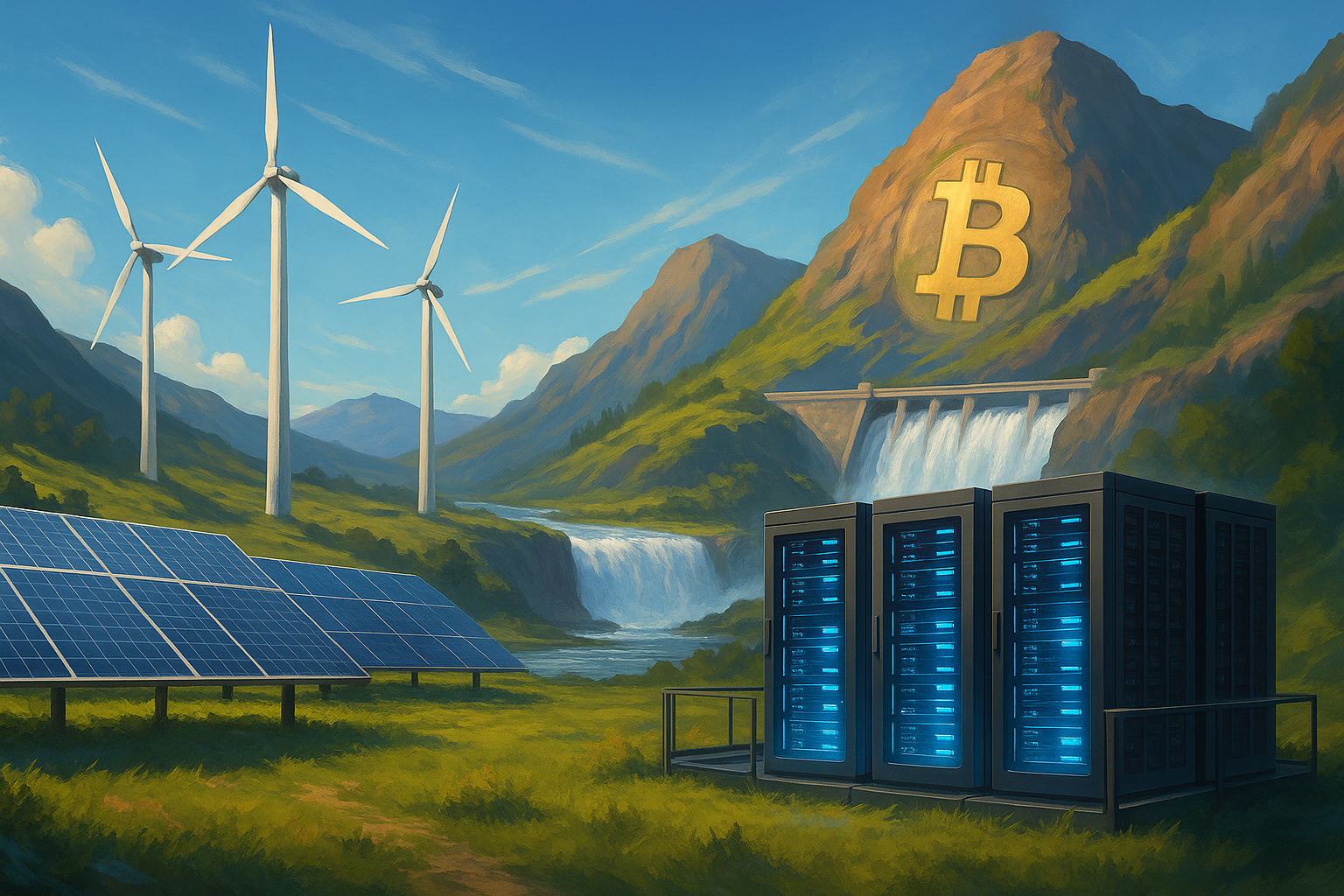
The criticism sounds simple. Bitcoin uses too much energy. But compared to what? That is the part most headlines skip.
Bitcoin secures a global monetary network on less energy than banking or gold mining. According to the Cambridge Digital Mining Industry Report (2025), Bitcoin mining increasingly gravitates toward low-cost energy sources: stranded renewablesClean power generated far from any city, with no transmission line to carry it to the people who need it., curtailed hydroHydroelectric power a dam could produce but cannot sell, because the grid has no room for it at that moment., nuclear, and wasted gas that would otherwise be burned off. The share running on sustainable sources has grown every year and now exceeds half. Methodologies for measuring this vary, but the direction is consistent. Cheap electricity and clean electricity increasingly overlap, and miners follow both. Source: Cambridge Digital Mining Industry Report 2025
How Bitcoin Mining Uses Flared Natural Gas
Flared natural gasGas that surfaces during oil drilling and gets burned off on site, because no pipeline exists to carry it to market. is one of the dirtiest forms of energy waste on the planet. That gas is now being routed into Bitcoin mining rigs instead of into the sky. On-site rigs burn the same methane at 99.89% efficiency, against roughly 93% for a standard flare, which cuts net emissions from the well. Some Bitcoin mining is literally cleaning up the energy industry’s waste. Source: Braiins, mining Bitcoin with stranded gas

During the August 2023 Texas heat wave, the grid operator ERCOTThe Electric Reliability Council of Texas, which runs the power grid for most of the state. paid the Bitcoin miner Riot Platforms $31.7 million to power down during peak demand. Because miners can switch off in seconds, they act as a flexible load that steadies the grid instead of straining it. That month, Riot earned more from powering down than from mining. Source: CNBC, September 2023
Bitcoin Energy Use Compared to Banking and Gold Mining
Armored trucks idle through city traffic to move paper cash. ATM networks glow through the night across every timezone. Bank data centers run cooling systems around the clock. Gold mining blasts open landscapes, uses cyanide leaching, and burns diesel across operations on every continent. The World Gold Council estimated the gold industry’s Scope 1 and 2 emissions at over 100 million tonnes of CO₂ equivalent in a single year. Source: World Gold Council
Nobody calls gold environmentally irresponsible. Nobody demands that banks justify their kilowatt-hours. Bitcoin’s energy use gets scrutinized more aggressively than many older systems it competes with. Some of that scrutiny reflects legitimate environmental concern. Some of it reflects unfamiliarity with what Bitcoin actually does and why its design requires energy in the first place.

The traditional financial system runs on energy too. That cost is not measured in headlines.
Why Bitcoin Uses Proof of Work
Everything up to here measured how much energy Bitcoin uses and how clean it is. The deeper question is the one the critics skip. Why does it need to use energy at all? Answer that, and the energy stops looking like a bill and starts looking like the design.
Bitcoin runs a global monetary settlement network with no head office, no board of directors, and no ability for any government to freeze your account. That is what the energy buys. A decentralized network where every transaction is verified by independent nodes and every rule is enforced by code, not by people.
Compared to everything else we have built to protect and move value, that is not even that expensive.
Energy use is what makes Bitcoin trustworthy.All Roads Lead to Bitcoin
When people understand what Bitcoin is (a fixed-supply, censorship-resistant monetary network with no central point of control), the energy question changes. It stops being “why does it use so much?” and becomes “is this worth the cost?” Whether the cost is justified depends on whether you think open, apolitical money is worth anything.
The Bitcoin Standard is not built on waste. It is built on proof of work, the only method proven at global scale for settling money with finality and no central authority in charge. Bitcoin is the first monetary system that ties its integrity to physics rather than trust. New bitcoin cannot be willed into existence by decree or by a vote. It takes real energy, real hardware, and open competition to produce. Picture the difference between a banknote backed by a promise and one backed by a physical cost nobody can fake. Take the energy away and you remove the one thing that makes the ledger impossible to forge.
Go Deeper
The case for money secured by real cost, and why proof of work’s energy is the feature that makes the ledger impossible to fake, not a flaw to engineer away.
How money’s settlement evolved, and why a network that secures itself with energy is a clean break from the trust-based systems that came before it.
Why technology keeps making things cheaper, and how a fixed, energy-backed money fits a world that grows more abundant, not more expensive.
Want the shorter version? The Did You Know post covers this one in brief, and the infographic version lays out the argument in one shareable one-pager.
Prefer to watch?
This myth is also a short video. It walks through the same evidence, the banking and gold comparison, and the shift to sustainable mining, in a few minutes.
Common Questions About Bitcoin’s Energy Use
Does Bitcoin really use more energy than entire countries?
Some comparisons frame Bitcoin’s 138 TWh annual consumption against smaller nations’ electricity use, which sounds alarming until you apply the same measure to banking or gold. Galaxy Digital’s 2021 research put the global banking system at roughly 263 TWh per year and gold mining at around 240 TWh. Country comparisons work as a headline but do not tell you whether the energy is justified relative to what a system actually delivers.
Is most Bitcoin mining powered by renewable energy?
As of the Cambridge Digital Mining Industry Report (2025), around 52.4% of Bitcoin mining runs on sustainable energy sources including renewables and nuclear. The share has grown steadily because miners follow the cheapest electricity on earth, and cheap electricity increasingly means stranded hydro, curtailed wind, and other clean sources that would otherwise go unused.
What is proof of work and why does it use so much energy?
Proof of work is Bitcoin’s consensus mechanism. Miners compete to solve computational puzzles; the winner adds the next block to the blockchain and earns newly issued bitcoin. The energy cost makes it expensive to attack the network or rewrite transaction history. No central authority verifies transactions. The energy expenditure itself is the verification. That is what keeps Bitcoin’s monetary policy fixed and its ledger tamper-resistant.
Can Bitcoin mining actually reduce carbon emissions?
In some cases, yes. Flared natural gas (methane burned off at oil wells with no infrastructure to capture it) is one of the most wasteful and polluting practices in the energy industry. Some Bitcoin miners now consume that gas on-site, combusting it at higher efficiency than standard flaring. The net result is fewer emissions than would have occurred without the mining operation.
How is Bitcoin’s energy use different from Ethereum or other cryptocurrencies?
Bitcoin uses proof of work by design. Ethereum switched to proof of stake in 2022, which uses far less energy but relies on economic stake rather than physical work to secure the network. Bitcoin’s developers and community have deliberately maintained proof of work because it provides a form of decentralization and attack resistance that proof-of-stake systems have not yet replicated at the same scale.
From the book
This myth is one chapter of Reasonable Doubt.
All twenty myths from this series, revised and rechecked, in one book you can read start to finish or hand to the skeptic in your life. Same standard as the site: the strongest version of each objection, the evidence, and a verdict that goes no further than the evidence does.
Paperback · $9.99 Kindle · $4.99 or free with Kindle Unlimited Listen on Spotify
New to Bitcoin? Start with the free guide, You Just Came Into Money. Now What?
Twenty myths. Twenty clean answers.
Explore all 20 myths →More from the Bitcoin Myths Series
Everything on this site is for educational purposes only. It is not financial, investment, tax, or legal advice. Bitcoin carries real risk. Prices move. Do your own research, think for yourself, and speak with a qualified professional before acting on anything you read here.