
New here? See how we test every claim →
Bitcoin Myths · #7 of 20
Bitcoin Has No Physical Form and No Real-World Utility. The Evidence Disagrees.
The claim bundles two separate objections. The first is factually wrong. Bitcoin is anchored to physical hardware, energy infrastructure, and over 39,000 physical locations worldwide. The second misunderstands what utility means. Bitcoin transferred $1.2 billion for $124 in fees on a documented transaction. It has maintained 99.98% uptime since 2009. A Texas grid operator paid a Bitcoin miner $31.6 million for real-world load management. The documented record is substantial.
Bitcoin has no physical coin or banknote, but it runs on physical machines consuming real energy across 181 countries. Its utility is specific and documented. It settles transfers at any scale for fees that are negligible relative to the amount moved, it has run for sixteen years without interruption, and it performs verified demand-responseA program where large electricity users get paid to cut or shut off their power use when the grid is under stress. services on power grids. The objection confuses form with substance. What gives Bitcoin value is not its shape. It is what the network does, and what it cannot be made to stop doing.
The objection has two parts, and they need to be addressed separately. One is about form, the claim that Bitcoin has no physical object you can hold. The other is about function, the claim that Bitcoin has no useful purpose in the real world. Both carry a surface plausibility. Both collapse under inspection.
Nobody asks to hold the internet before deciding whether it is useful. A system is defined by what it does, not by whether it can sit on a shelf.
Money Was Already Digital Before Bitcoin
In 1971, the United States severed the dollar’s connection to gold. Since then, the dollar has been a number maintained by banks and governments, a claim on purchasing power backed by institutional trust. When you transfer money between accounts, no physical object moves. A database entry changes. The same is true of every major currency on Earth.
This is not a criticism of the dollar. It is the context necessary to evaluate the claim against Bitcoin fairly. The objection “Bitcoin is not physical” applies equally to every bank balance, every wire transfer, every central bank reserve. If the absence of physical form disqualified a monetary system, the global financial infrastructure would fail the test. Bitcoin’s critics rarely apply this standard consistently.
Bitcoin is, in one sense, the most candid version of this arrangement. It does not pretend to be backed by a physical object it is not connected to. The Bitcoin Standard is a fixed-supply monetary network enforced by code, not by a central bank’s promise. Its value comes from what the network is and does, not from a redeemable claim on something in a vault.
The Physical Layer: Machines, Buildings, and Energy
The ledger is digital. The infrastructure that maintains it is not.
Every Bitcoin transaction is validated and recorded by full nodes. These computers, running the Bitcoin software, maintain a complete copy of the blockchain. As of 2025, Bitnodes.io counted over 21,000 reachable full nodes operating across 181 countries. Many run on consumer hardware. A significant portion run on Raspberry Pis, small single-board computers that cost under $100. The decentralization of that node network is the reason no government, company, or individual can alter the rules of the system by capturing a single point.
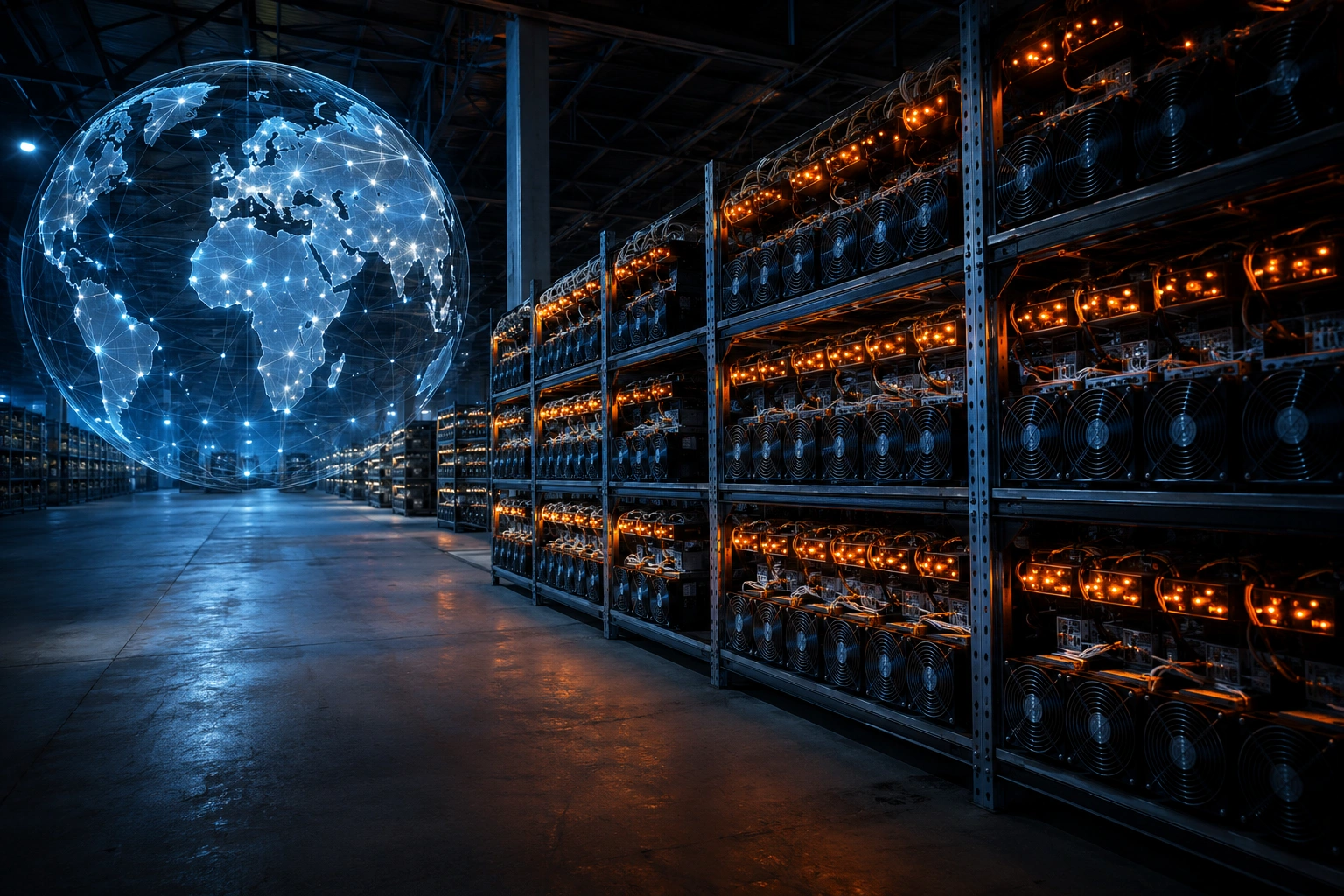
Mining hardware is more substantial still. Bitcoin’s proof-of-workA consensus rule where miners spend real energy to add blocks, making the chain’s history expensive to rewrite. consensus requires specialized ASICApplication-Specific Integrated Circuit. A chip built for one task only; Bitcoin ASICs do nothing but compute the hashes that secure the network. machines built for no other purpose than computing SHA-256 hashes. These machines run in warehouses and container facilities around the world, consuming measurable, auditable amounts of electrical power. The energy is not accidental to the system. It is the security mechanism. The cost of that energy makes the blockchain’s history expensive to rewrite and the network expensive to attack.
And then there are the physical access points. Over 39,000 Bitcoin ATMs operate globally as of Q1 2026, with roughly 30,000 in the United States alone. They sit in grocery stores, gas stations, convenience stores, and shopping centers. Someone who wants to exchange cash for Bitcoin in a rural town with no smartphone can walk up to a machine and do it. The argument that Bitcoin has no physical presence does not survive a drive down a commercial strip in many American cities.

The Bitcoin network has experienced only two downtime events in its entire history, eight hours in August 2010 and six hours in March 2013. It has had zero downtime since March 2013, giving it a 99.98% uptime record over more than 16 years of continuous operation. No bank, payment processor, or financial infrastructure of comparable scale and global reach has a comparable record. Source: bitcoinuptime.org
Proof-of-Work: The Physical Cost Behind Every Block
The proof-of-work mechanism deserves its own consideration because it answers a different form of the “no physical form” objection, the idea that Bitcoin is purely computational and therefore arbitrary.
Every block added to the Bitcoin blockchain required miners to expend real electrical energy solving a computational puzzle. That energy expenditure is verifiable. It cannot be faked. The difficulty of the puzzle adjusts automatically every two weeks to maintain a roughly ten-minute average block time regardless of how much computing power is directed at the network. The result is a chain where each block represents a measurable quantity of real-world work, and where altering historical blocks would require repeating that work.
Vijay Boyapati, in The Bullish Case for Bitcoin, puts this at the center of Bitcoin’s monetary function. The cost of production is unforgeable. You can print dollars, but you cannot print proof-of-work, because every block of it is energy that was actually spent. Bitcoin’s energy use is not waste in the way critics often frame it. It is the physical anchor that makes the digital record trustworthy without requiring a trusted third party to vouch for it.
What Bitcoin Makes Possible Without Intermediaries
The claim that Bitcoin has no real utility is weaker than the claim that it has no physical form, because its utility is documented rather than theoretical. Three categories of it are worth examining precisely because each one represents something no alternative network currently replicates.
The first is final settlement of large transfers at negligible cost, the kind that moved $1.2 billion for $124. The second is censorship-resistant value transfer with no intermediary, money that can cross a border or a blockade without asking anyone’s permission. The third is programmable demand-response on power grids, a mining load a grid operator pays to switch off within seconds when demand spikes.
Settlement at Any Scale, for Almost No Cost
Bitcoin fees are calculated by transaction size in bytes, not by the dollar value being moved. A transaction that transfers $1 billion occupies roughly the same amount of block space as one transferring $100. The fee pays for that space, not for the amount. The practical result has been documented on-chain in transactions that have no parallel in traditional finance:
| Amount Transferred | Fee Paid | Fee as % of Transfer |
|---|---|---|
| $1,200,000,000 | $124 | 0.00001% |
| $670,000,000 | $0.26 | 0.00000004% |
| $1,000,000,000+ | Under $1.00 | Less than 0.0000001% |
A domestic wire transfer at a US bank typically costs $15 to $35. An international wire runs $35 to $75 or more. For large institutional transfers, fees are often calculated as a percentage of the amount, with correspondent bank charges added on top. A $1.2 billion international transfer through the traditional banking system would cost orders of magnitude more than $124, take one to five business days, and require both sender and receiver to maintain accounts at institutions with the appropriate correspondent bankingAn arrangement where banks hold accounts with one another to move money across borders, often with limited transparency. relationships.
The Bitcoin transaction settled in the next block. No business hours. No geography. No correspondent bank required.
The same is true far below a billion dollars. A migrant worker sending $200 home loses a punishing share to remittance fees and waits days for it to clear. Bitcoin moves that $200 in minutes, for a few cents, to anyone with a phone and no bank account at either end. Where capital controls trap savings or a currency is collapsing, that is not a convenience. It is the difference between keeping what you earned and losing it.
Demand Response: Bitcoin’s Grid Utility
In August 2023, during a sustained heatwave in Texas, ERCOT (the Electric Reliability Council of Texas) paid a Bitcoin mining operator $24.2 million in curtailment credits plus $7.4 million in demand-response payments, totaling $31.6 million, for reducing load during peak grid stress periods. The payments are documented in ERCOT’s public data.
This is not a theoretical use case. It is a documented commercial transaction between a grid operator and a mining facility, in a real electricity market, during real supply stress events. The economics work because Bitcoin mining is a uniquely flexible electrical load. It can be scaled down or shut off within seconds without damaging the operation, and restarted just as quickly. No factory line, data center, or aluminum smelter can power down and restart like that without real cost.
The pattern repeated during Winter Storm Uri in 2021. Texas miners curtailed voluntarily to protect grid stability. When Winter Storm Heather hit in early 2024, they did it again. The power those machines released went to homes trying to stay warm through the kind of freeze that has killed people before.
That flexibility is only half of the energy story. The other half is what powers the machines when they are running. Cambridge Centre for Alternative Finance data from 2025 shows that 52.4% of Bitcoin mining globally draws from non-fossil fuel sources, with hydropower (23.4%) and wind (15.4%) as the leading contributors.
In August 2023 alone, ERCOT paid one Bitcoin mining operator $31.6 million in curtailment credits and demand-response payments for reducing load during a Texas heatwave. That is a grid operator paying a miner not to mine, because the ability to switch off instantly, at scale, was worth more to the grid than the electricity itself. Source: ERCOT public data
Bitcoin mining acts as a flexible load that can absorb excess power from renewable sources and release capacity to the grid during peak demand. Whether that translates to net environmental benefit is a separate, contested question. That it translates to real, documented, compensated grid utility is not.
The Network That Has Never Gone Down
Bitcoin has produced a block approximately every ten minutes since January 3, 2009. In more than sixteen years of operation, it has experienced two downtime events, eight hours in August 2010 and six hours in March 2013. Both were early-stage technical events. The network has had zero downtime since March 2013.
Few global financial systems have operated continuously for this long without centralized administration. Visa experiences periodic outages. PayPal has experienced outages. SWIFT, the interbank messaging system used for international wire transfers, has been exploited, hacked, and used as an instrument of sanctions enforcement, including being cut off from entire national banking systems. The Bitcoin network does not have administrators who can be pressured into restricting access. It does not have a headquarters that can be raided. It does not have a compliance department that can be lobbied into freezing an account.
This is what Adam Livingston, in The Bitcoin Age, calls the foundation of digital property rights, possession that cannot be revoked unilaterally by a third party. The 99.98% uptime is not just a reliability statistic. It is evidence that the system operates on its own terms, without reference to the political or institutional environment surrounding it.
For anyone assessing Bitcoin’s utility against a real alternative, the question is worth asking directly. What other financial infrastructure has operated continuously, without gatekeepers, across 181 countries, for sixteen years, settling transactions of any size, at any hour, for near-zero fees? To see how the other myths in this series hold up to the same scrutiny, explore the full Bitcoin Myths series.
Want the shorter version? Read the Did You Know post. Prefer a visual? The infographic version lays out the argument in one shareable one-pager.
Prefer to watch?
This myth is also a short video. It walks through the same idea in a few minutes: money was already digital, and Bitcoin’s “physical form” is a real layer of nodes, miners, and energy.
Common Questions About Bitcoin’s Physical Form and Utility
Does Bitcoin have any physical form?
Bitcoin has no physical coin or note, but it runs on physical infrastructure that includes ASIC mining hardware, full nodes operating on computers in 181 countries, hardware wallets, and over 39,000 Bitcoin ATMs worldwide. Every block in the chain required real electrical energy to produce. The physical layer is not decoration. It is the security model. The energy expenditure is what makes the blockchain’s history expensive to alter and the network expensive to attack.
What is Bitcoin actually useful for?
Bitcoin’s documented utilities include final settlement of large transfers at negligible cost (one documented transaction moved $1.2 billion for $124 in fees), near-zero-fee instant payments via the Lightning Network, censorship-resistant value transfer across borders without intermediaries, and grid demand-response services. In August 2023, ERCOT paid a Bitcoin miner $31.6 million for load management during a Texas heatwave.
How reliable is the Bitcoin network?
Bitcoin has maintained 99.98% uptime since the genesis block on January 3, 2009. There have been two recorded downtime events in the network’s history, eight hours in 2010 and six hours in 2013. The network has had zero downtime since March 2013. No payment network or financial infrastructure of comparable scale and global reach has a comparable reliability record.
Why are Bitcoin transaction fees so low for large transfers?
Bitcoin fees are calculated by transaction size in bytes, not by the dollar value being transferred. A transaction moving $1 billion occupies roughly the same block space as a transaction moving $100. The fee pays for that space, not for the amount. A wire transfer fee, by contrast, is calculated as a percentage of the transfer amount, making large transfers expensive through traditional channels. Bitcoin’s fee structure is indifferent to denomination.
Is Bitcoin considered digital gold?
The comparison has substantive merit. Both have a fixed supply, both require real work to produce, and both have historically functioned as stores of value outside the banking system. Bitcoin’s fixed supply of 21 million bitcoin is enforced by code verifiable by any full node. Gold’s supply is bounded by geology. The “digital gold” framing is widely used and analytically grounded. Bitcoin also has capabilities gold does not. It offers instant global transfer, eight decimal places of divisibility, and cryptographic proof of ownership without a custodian.
Go Deeper
The three books that shaped the arguments in this article. Each one is worth reading in full.
The clearest treatment of Bitcoin as a monetary asset. Boyapati’s framework for understanding proof-of-work as unforgeable cost of production is the intellectual foundation for this article’s physical infrastructure argument.
The economic case for Bitcoin as sound money. Ammous covers divisibility, scarcity, portability, and durability with the rigor of an economist, not an advocate. The chapters on monetary history are essential context for understanding why those qualities matter.
A more recent and underread contribution. Livingston builds the case for Bitcoin as a new form of property right, ownership that cannot be revoked without the holder’s cooperation. His framework for digital ownership is the right lens for understanding why the network’s uptime record matters beyond mere reliability.
From the book
This myth is one chapter of Reasonable Doubt.
All twenty myths from this series, revised and rechecked, in one book you can read start to finish or hand to the skeptic in your life. Same standard as the site: the strongest version of each objection, the evidence, and a verdict that goes no further than the evidence does.
Paperback · $9.99 Kindle · $4.99 or free with Kindle Unlimited Listen on Spotify
New to Bitcoin? Start with the free guide, You Just Came Into Money. Now What?
Twenty myths. Twenty clean answers.
Explore all 20 myths →More from the Bitcoin Myths Series
- All 20 Myths
- Myth #1 · Energy
- Myth #2 · Volatility
- Myth #3 · Crime
- Myth #4 · Bubble
- Myth #5 · Gov Ban
- Myth #6 · Divisibility
- Myth #7 · Physical Form
- Myth #8 · Altcoins
- Myth #9 · Real Estate
- Myth #10 · Wallets
- Myth #11 · Exchanges
- Myth #12 · Reset
- Myth #13 · Gold
- Myth #14 · Intrinsic Value
- Myth #15 · Greater Fool
- Myth #16 · Miners
- Myth #17 · Ponzi
- Myth #18 · Complexity
- Myth #19 · Acceptance
- Myth #20 · Unit of Account
Everything on this site is for educational purposes only. It is not financial, investment, tax, or legal advice. Bitcoin carries real risk. Prices move. Do your own research, think for yourself, and speak with a qualified professional before acting on anything you read here.